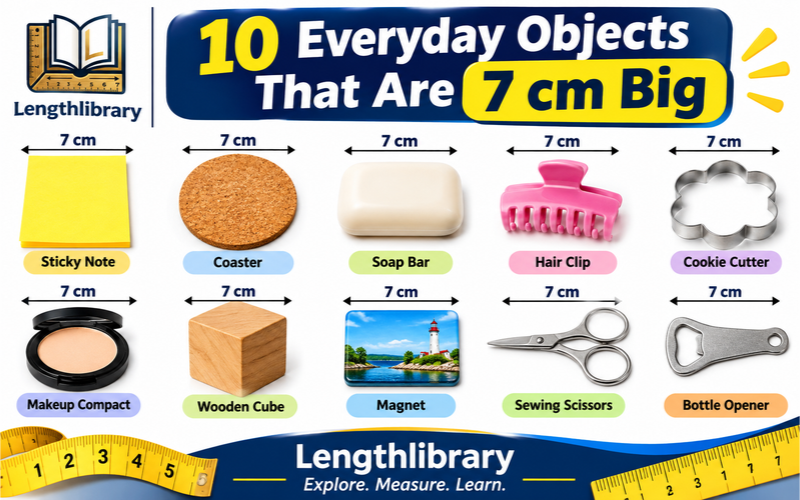
Have you ever wondered how big 7 centimeters really is? Although it sounds like a small measurement, 7 cm is a useful length that appears in many everyday objects. From stationery and household accessories to personal items and kitchen essentials, you can find plenty of familiar things that measure approximately 7 cm in one particular dimension.
Understanding the size of 7 cm becomes much easier when you compare it with objects you already use. Instead of relying only on a ruler, you can develop a better sense of this measurement by looking at familiar items and examining their length, width, or diameter.
In this guide, we will explore 10 common everyday objects that can measure exactly 7 cm (70 millimeters). Each example includes a description of its dimensions, practical uses, and an explanation of how it compares with this measurement.
Quick Answer: How Big Is 7 cm?
7 centimeters equals 70 millimeters or approximately 2.76 inches. It is a relatively short measurement, slightly less than 3 inches.
You can understand 7 cm by comparing it with objects such as:
- A square sticky note.
- A round coaster measuring.
- A small bar of soap.
- A compact hair clip.
- A small cookie cutter.
- A craft ruler or stationery accessory.
Remember that these are examples of objects available in or made to a 7 cm dimension. Their actual measurements depend on the particular product.
Understanding the Size of 7 cm
Before examining the objects, it helps to understand the measurement itself.
A centimeter is a metric unit used to measure relatively small distances, lengths, and dimensions. One centimeter equals 10 millimeters. Therefore, 7 cm contains 70 millimeters.
Here are some useful conversions:
| Measurement | Equivalent |
| Centimeters | 7 cm |
| Millimeters | 70 mm |
| Meters | 0.07 m |
| Inches | 2.76 inches |
| Feet | 0.23 feet |
It is important to measure from the actual starting edge rather than the beginning of the ruler itself, because some rulers have a small gap before their first marking.
1. A Square Sticky Note 📝
A square sticky note is one of the easiest stationery items to use when understanding a 7 cm measurement. Manufacturers produce sticky notes in different shapes and sizes, including compact square formats.

A sticky note measuring exactly 7 cm on each side provides a useful example of this measurement. Its length and width are both 70 millimeters, creating a square shape.
Dimensions of a 7 cm Sticky Note
- Length: 7 cm
- Width: 7 cm
- Shape: Square
- Thickness: Depends on the paper stock
- Material: Lightweight paper with an adhesive strip
Why Is It a Useful Comparison?
Sticky notes are common in schools, offices, homes, and study environments. People use them to write reminders, mark important pages, organize assignments, and leave short messages.
A 7 cm square sticky note offers enough writing space for a brief reminder without occupying much desk space.
You can also use it to understand the difference between length and area.
77=49cm2
This means the sticky note covers 49 square centimeters.
Where Can You Find It?
You can find square sticky notes in stationery shops, office supply stores, school bags, and home study areas. Check the package dimensions because many commonly sold sticky notes have different measurements.
2. A Round Coaster ☕
A small round coaster is another practical example of an object that can measure 7 cm across.

A coaster protects tables, desks, and other surfaces from moisture, heat, and drink stains. Manufacturers produce coasters in circular, square, and decorative designs.
For this comparison, consider a round coaster with a diameter of exactly 7 cm.
Dimensions of a Coaster
- Diameter: 7 cm
- Radius: 3.5 cm
- Shape: Circular
- Material: Cork, silicone, wood, or another suitable material
- Thickness: Varies by design
How Does It Compare With 7 cm?
The diameter represents the distance from one side of the circular coaster to the opposite side, passing through its center.
If you place a ruler across the middle, the distance should measure 70 mm.
Its radius is half the diameter:
r=72=3.5cm
The approximate surface area of this coaster is:
A=r2
A=3.52
A38.48cm2
Everyday Uses
People place coasters beneath tea cups, coffee mugs, glasses, and small drinking containers. A 7 cm coaster can accommodate some compact cups and glasses, depending on their base diameter.
This object provides a particularly useful comparison because you can easily recognize its circular shape and measure its width.
3. A Bar of Soap 🧼
Soap is an everyday household and personal hygiene product. You can find it in bathrooms, kitchens, hotels, schools, and workplaces.
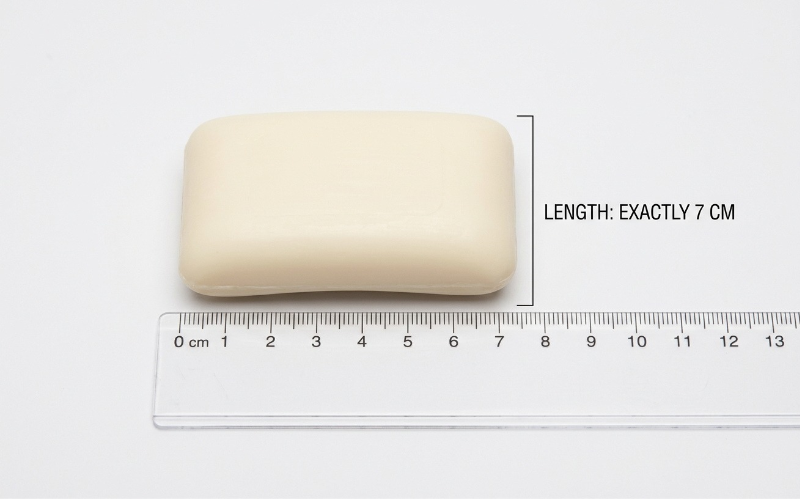
Small soap bars come in several shapes and sizes. Some manufacturers produce compact rectangular bars with a length of approximately 7 cm.
For an exact comparison, select a soap bar whose longest side measures 70 mm.
Dimensions of a Soap Bar
- Length: 7 cm
- Width: Depends on the design
- Height: Depends on the design
- Shape: Usually rectangular or oval
- Material: Solid cleansing soap
Why Is a Soap Bar a Good Example?
Soap bars have a familiar shape and are easy to handle. Their compact dimensions make them useful for understanding relatively short measurements.
A soap bar can fit comfortably in many soap dishes, travel containers, and bathroom storage spaces.
The measurement also helps when comparing different soap products. A travel-size bar generally takes up less room than a larger household soap bar.
How to Measure It
Place the soap on a flat surface. Align the zero mark of a ruler with one end and check whether the opposite end reaches 7 cm.
Avoid measuring along a curved edge. Measure the straight-line distance between the two ends.
Soap bars gradually become smaller with use, so an object that originally measured 7 cm may no longer retain its original dimensions.
4. A Hair Clip 💇♀️
Hair clips come in many shapes, colors, and sizes. People use them to hold hair in place, create hairstyles, and keep loose strands away from their faces.
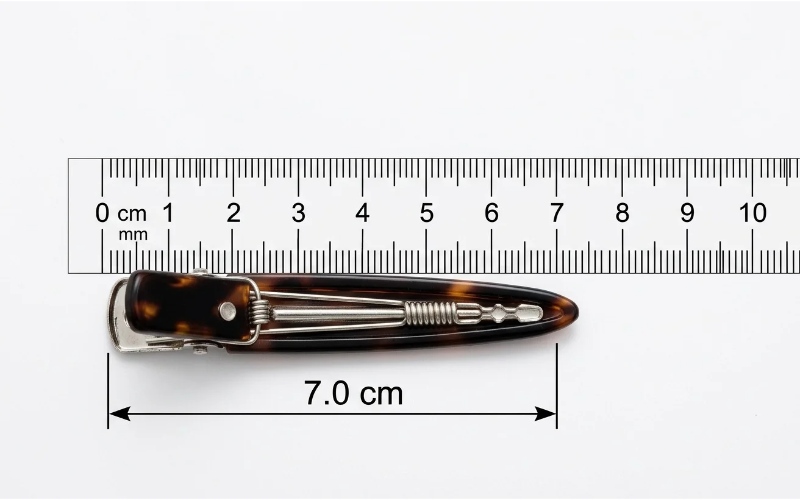
A compact hair clip measuring 7 cm from end to end provides another familiar example.
Dimensions of a Hair Clip
- Overall length: 7 cm
- Width: Varies by clip design
- Material: Plastic, metal, or a combination
- Shape: Curved, rectangular, or claw-style
- Function: Holds and secures hair
Why Does Its Size Matter?
Hair clips need to balance convenience and holding capacity. A smaller clip is useful for securing sections of hair, while larger designs can hold thicker or longer sections.
A 7 cm hair clip offers a convenient size for everyday grooming and storage.
You can keep one inside a handbag, makeup pouch, dressing table drawer, or travel kit.
How to Compare It With 7 cm
Measure the longest straight-line distance from one end of the clip to the other.
For a curved clip, do not follow the curved surface with a measuring tape if you want its overall length. Measure the maximum straight-line distance instead.
This distinction matters because an object’s curved surface length can differ from its overall end-to-end measurement.
5. A Cookie Cutter 🍪
Cookie cutters are useful kitchen accessories that help create biscuits and cookies in consistent shapes. They come in circular, square, heart-shaped, star-shaped, and decorative designs.

A cookie cutter with a 7 cm diameter provides an excellent example of this measurement.
Dimensions of a Cookie Cutter
- Diameter: 7 cm
- Shape: Circular in this example
- Material: Stainless steel or food-safe plastic
- Height: Depends on the cutter design
- Purpose: Cutting cookie dough into shapes
How Is 7 cm Used in Baking?
The diameter determines the approximate width of the cookie shape produced by a circular cutter.
A 7 cm cutter creates a relatively small-to-medium circular cookie, depending on the recipe and dough thickness.
Bakers use cookie cutters to prepare:
- Homemade biscuits
- Sugar cookies
- Decorative cookies
- Pastry shapes
- Small sandwich biscuits
How to Measure It
Place the cutter on a flat surface and measure across its opening from one outer edge to the opposite outer edge.
If the diameter measures 70 mm, it provides an exact 7 cm comparison.
Remember that cookie cutters are available in many sizes, so always check the product specifications.
6. A Makeup Compact 💄
Makeup compacts are common personal care accessories. They usually contain pressed powder, a small mirror, or other cosmetic products.

Many compact cases have a circular or rounded design. A small compact with a diameter of exactly 7 cm provides a useful size comparison.
Dimensions of a Makeup Compact
- Diameter: 7 cm
- Shape: Circular or rounded
- Material: Plastic, metal, or durable cosmetic packaging
- Contents: Powder, mirror, or other makeup products
- Thickness: Depends on the product
Why Is This Size Practical?
A 7 cm compact is convenient for carrying in a handbag, purse, or makeup pouch.
Its small size also makes it easier to store with other personal accessories.
People commonly use makeup compacts for quick touch-ups during work, travel, shopping, and social occasions.
Comparing the Compact With 7 cm
Measure across the widest part of the closed compact.
If the measurement reaches 70 mm, the compact is exactly 7 cm across.
Do not confuse diameter with circumference. The circumference measures the distance around the circular object, while the diameter measures the straight distance through its center.
7. A Wooden Craft Cube 🧊
Wooden cubes are popular craft and educational materials. People use them for school projects, home decorations, model building, counting activities, and creative experiments.
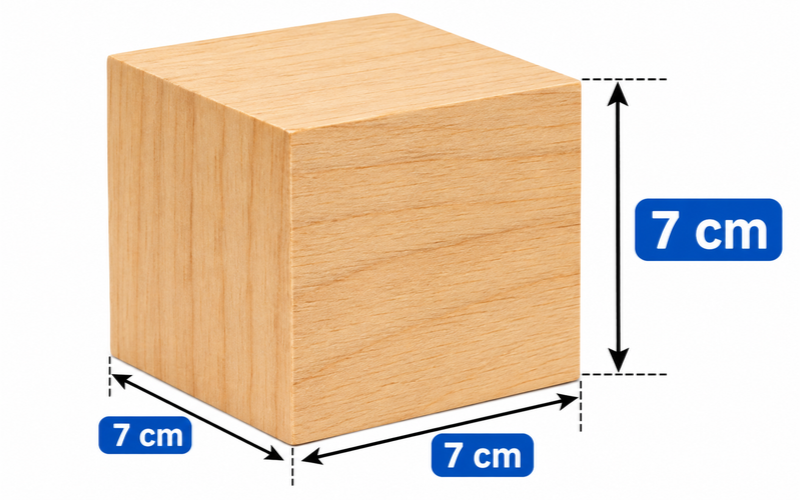
A wooden cube measuring 7 cm on each side is a clear three-dimensional example of this measurement.
Dimensions of a Wooden Cube
- Length: 7 cm
- Width: 7 cm
- Height: 7 cm
- Shape: Cube
- Material: Wood
- Surface: Natural, painted, or polished
Understanding Its Three Dimensions
Unlike a flat object, a cube has three equal dimensions.
Each edge measures exactly 7 cm. This makes it a useful way to understand length, width, and height simultaneously.
Its volume can be calculated using:
V=s3
Where s represents the length of one side.
Therefore:
V=777
V=343cm3
The wooden cube has a volume of 343 cubic centimeters.
Where Can You Find It?
You may find wooden cubes in craft shops, educational supply stores, toy collections, and DIY project materials.
They are particularly useful for teaching children basic geometry and helping them understand three-dimensional measurements.
8. A Refrigerator Magnet 🧲
Refrigerator magnets are familiar household accessories. People use them to decorate refrigerators, attach shopping lists, display photographs, and hold important reminders.

A rectangular refrigerator magnet measuring 7 cm across is another convenient example.
Dimensions of a Refrigerator Magnet
- Width: 7 cm
- Height: Depends on its shape
- Thickness: Usually relatively small
- Material: Plastic, rubber, wood, or decorative metal
- Backing: Magnetic material
Why Is It a Useful Comparison?
Magnets are usually small enough to fit comfortably in your hand. Their dimensions also make them easy to compare with a ruler.
A 7 cm-wide refrigerator magnet can provide enough surface space for a short message, decorative illustration, or small photograph.
You can find these accessories in homes, offices, souvenir shops, and gift stores.
How to Measure It
For a rectangular magnet, place a ruler along its longest horizontal edge.
If the distance from one end to the other measures 70 mm, its width is exactly 7 cm.
Some decorative magnets have irregular outlines. In those cases, measure the maximum horizontal or vertical dimension rather than following the shape’s outer curves.
9. A Sewing Scissors ✂️
Small sewing scissors are useful tools for cutting thread, trimming fabric edges, and completing detailed craft projects.
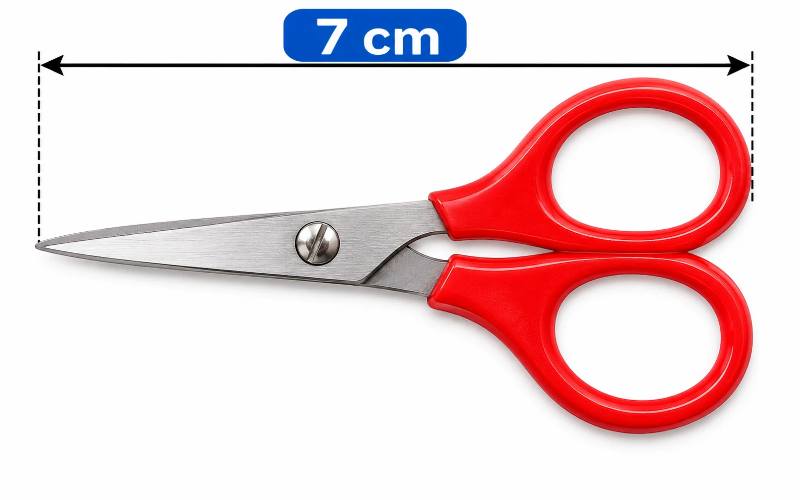
Although scissors come in different lengths, compact embroidery scissors are available in small formats. A specially selected pair measuring 7 cm overall provides a useful example.
Dimensions of a Sewing Scissors
- Overall length: 7 cm
- Material: Stainless steel or another suitable metal
- Handle: Small finger loops
- Blades: Short pointed or rounded cutting edges
- Purpose: Fine cutting and sewing work
Why Are Small Scissors Useful?
Large household scissors are not always suitable for delicate work. Smaller sewing scissors provide better control when trimming loose threads or cutting small sections of fabric.
A compact 7 cm pair can fit inside a sewing kit, craft box, or small storage pouch.
How to Measure It
Close the scissors completely and measure from the tip of the blades to the farthest end of the handle.
This gives the overall length.
Do not measure only the blades or handles because those represent individual parts rather than the complete object’s length.
Safety note: Keep scissors closed when storing them, and keep pointed sewing tools away from young children.
10. A Bottle Opener 🍾
A compact bottle opener is a familiar kitchen and household accessory. People use it to remove bottle caps from suitable glass bottles.

Some handheld openers have a compact design with an overall length of 7 cm.
Dimensions of a Bottle Opener
- Overall length: 7 cm
- Width: Depends on the design
- Material: Stainless steel, steel alloy, or durable metal
- Shape: Flat, rounded, or compact
- Function: Removes suitable bottle caps
Why Is It a Good Everyday Example?
Bottle openers are generally simple tools with recognizable shapes. Their compact designs make them easy to store in kitchen drawers, picnic bags, and travel accessories.
A 7 cm opener is a useful example because you can measure its overall length directly.
How to Check Its Size
Place the opener on a flat surface. Measure from its farthest end to the opposite end using a metric ruler.
The measurement should reach 70 mm for an exact 7 cm match.
Different bottle openers have different dimensions, so check the actual model rather than assuming that all compact openers measure 7 cm.
Quick Comparison: All 10 Objects That Measure 7 cm
Here is a simple reference table summarizing the objects discussed in this article.
| Everyday object | Dimension measuring 7 cm |
| Square sticky note | Length and width |
| Round coaster | Diameter |
| Bar of soap | Length |
| Hair clip | Overall length |
| Cookie cutter | Diameter |
| Makeup compact | Diameter |
| Wooden craft cube | Length, width, and height |
| Refrigerator magnet | Width |
| Sewing scissors | Overall length |
| Bottle opener | Overall length |
This table makes it easier to identify which measurement to check when comparing an object with 7 cm.
Other Interesting Ways to Visualize 7 cm
The objects above provide practical examples, but there are several other ways to develop a better understanding of this measurement.
Compare 7 cm With an Ordinary Ruler
A metric ruler is one of the simplest tools for understanding centimeters. Most school rulers display centimeter and millimeter markings.
Find the zero mark and count seven centimeters along the ruler. The distance between zero and seven represents exactly 7 cm.
You can also count the smaller markings. Each centimeter contains 10 millimeters, so seven centimeters contain 70 individual millimeters.
Compare 7 cm With 3 Inches
Three inches equal 7.62 cm. Therefore, 7 cm is slightly shorter than 3 inches.
The difference is:
7.62-7=0.62cm
This means 7 cm is approximately 0.62 cm shorter than 3 inches.
This comparison is particularly useful for people who regularly use imperial measurements.
Compare 7 cm With Your Hand
Your hand can provide a convenient visual reference, although hand sizes differ from person to person.
You can place a ruler alongside your index finger and identify a section measuring 7 cm. Once you become familiar with that distance, you may find it easier to estimate similar lengths.
However, your hand should only serve as an informal comparison. Use a ruler whenever you need an accurate measurement.
Compare 7 cm With a Small Square
A square measuring 7 cm on each side provides another easy visual example.
Its four sides have equal lengths, and its surface area is 49 square centimeters.
This comparison helps distinguish between a linear measurement and a two-dimensional measurement.
How to Measure an Object That Is Exactly 7 cm
If you want to verify whether an everyday object measures exactly 7 cm, follow a few simple steps.
Step 1: Choose the Correct Measuring Tool
Use a metric ruler or measuring tape that displays centimeters and millimeters.
A ruler with clear markings makes it easier to identify the 7 cm point.
Step 2: Place the Object on a Flat Surface
Place your object on a table or another level surface. This helps prevent incorrect measurements caused by movement or uneven positioning.
Step 3: Align the Starting Point
Place the zero mark of the ruler at one end of the object.
Do not automatically align the object with the physical edge of the ruler because some rulers have a small unmarked space before the zero point.
Step 4: Identify the 7 cm Mark
Look for the 7 cm marking, which is equivalent to 70 mm.
If the opposite edge reaches this mark, the measured dimension is 7 cm.
Step 5: Check the Correct Dimension
Different objects require different measuring methods.
For example:
- Measure the diameter of a circular coaster.
- Measure the length of a rectangular soap bar.
- Measure all three edges of a cube.
- Measure the overall length of scissors.
- Measure the width of a rectangular magnet.
Always identify whether you need the length, width, height, diameter, or thickness.
Why Is Understanding 7 cm Useful in Everyday Life?
Understanding small measurements can help with several practical activities. You do not always need professional measuring equipment to make simple comparisons, but knowing the approximate size of common objects can make everyday tasks easier.
1. Shopping for Small Household Items
When shopping online, product dimensions help you determine whether an item will fit into your available space.
For example, knowing that 7 cm is approximately 2.76 inches can help you understand the size of a compact accessory, coaster, or storage item.
2. Completing School and Craft Projects
Students regularly work with paper, cardboard, wooden pieces, and other materials.
A 7 cm measurement can help when drawing shapes, preparing models, creating decorations, and completing geometry assignments.
3. Understanding Product Dimensions
Online stores often display dimensions in centimeters, millimeters, or inches.
Understanding these units makes it easier to compare different products and avoid purchasing something that is too large or too small.
4. Improving Measurement Skills
Comparing familiar objects with standard measurements helps develop estimation skills.
Over time, you can become better at recognizing whether an object is closer to 5 cm, 7 cm, or 10 cm without immediately reaching for a ruler.
5. Learning Basic Mathematics
The measurement of 7 cm also provides opportunities to practice mathematical concepts.
For example, you can calculate the area of a square, the circumference of a circle, or the volume of a cube using objects with known dimensions.
These activities make mathematics more practical and easier to understand.
BioWiki: 7 cm Measurement Facts
The following table provides a quick reference for understanding the measurement and its everyday applications.
| BioWiki Detail | Information |
| Measurement | 7 centimeters |
| Symbol | 7 cm |
| Metric equivalent | 70 millimeters |
| Meter equivalent | 0.07 meters |
| Inch equivalent | Approximately 2.76 inches |
| Measurement category | Length |
| Measurement system | Metric system |
| Common measuring tool | Metric ruler |
| Suitable applications | Stationery, household items, crafts, and personal accessories |
| Square area | 49 cm² |
| Cube volume | 343 cm³ |
| Practical comparison | A 7 cm square sticky note |
| Measurement accuracy | Verify the specific object’s dimensions |
Frequently Asked Questions (FAQs) ❓
1. How big is 7 cm in everyday measurements?
Seven centimeters is approximately 2.76 inches. It is a relatively small length that you can compare with a compact coaster, a small soap bar, or a specially sized stationery item.
2. Is 7 cm bigger or smaller than 3 inches?
Seven centimeters is smaller than 3 inches. Three inches equal approximately 7.62 cm, making 7 cm shorter by 0.62 cm.
3. How many millimeters are in 7 cm?
There are exactly 70 millimeters in 7 centimeters. Since every centimeter contains 10 millimeters, multiplying 7 by 10 gives 70 mm.
4. What common objects can measure exactly 7 cm?
Several everyday objects are available in 7 cm sizes. Examples include square sticky notes, round coasters, compact soap bars, small hair clips, cookie cutters, makeup compacts, wooden craft cubes, refrigerator magnets, sewing scissors, and bottle openers.
However, not every version of these objects measures exactly 7 cm. Check the specific product dimensions before using it as an exact reference.
5. Can I use my fingers to estimate 7 cm?
Yes, you can use your fingers as an informal reference. However, finger lengths vary between individuals. For an accurate measurement, use a metric ruler or measuring tape.
6. How can I measure 7 cm without a ruler?
You can use a measuring tape, a metric scale printed on suitable stationery, or another object with a verified 7 cm dimension. You can also use a properly calibrated digital measuring tool.
Avoid relying on guesses when accuracy matters.
7. Is 7 cm the same as 70 mm?
Yes. Both measurements represent exactly the same length. Seven centimeters equal 70 millimeters because one centimeter contains 10 millimeters.
8. What is the area of a 7 cm square?
The area of a square with 7 cm sides is 49 square centimeters.
The calculation is:
A=77=49cm2
9. What is the volume of a 7 cm cube?
A cube with sides measuring 7 cm has a volume of 343 cubic centimeters.
You calculate its volume by multiplying its length, width, and height:
V=777=343cm3
10. How do I convert 7 cm into inches?
To convert centimeters into inches, divide the centimeter measurement by 2.54.
72.542.7559
Therefore, 7 cm is approximately 2.76 inches.
11. Is 7 cm considered a small measurement?
Yes, 7 cm is relatively small compared with everyday measurements such as meters or feet. However, it is large enough to describe many household accessories, stationery products, and personal items.
12. Why do some objects advertised as 7 cm have slightly different measurements?
Manufacturing tolerances, product designs, packaging, and measurement methods can create small differences. Some manufacturers also round dimensions to the nearest centimeter.
If you require an exact 7 cm measurement, check the manufacturer’s specifications and verify the object with a measuring tool.
More Measurement Guides
- 10 Common Everyday Objects That Are Exactly 6 cm Big
- 10 Common Everyday Objects That Are Exactly 5 cm Big
- 10 Common Everyday Objects That Are Exactly 4 cm Big
- 10 Common Everyday Objects That Are Exactly 3 cm Big
- 10 Common Everyday Objects That Are Exactly 2 cm Big
Conclusion 📏
Seven centimeters is a useful everyday measurement that becomes easier to understand when you compare it with familiar objects. A square sticky note, round coaster, small soap bar, hair clip, cookie cutter, makeup compact, wooden cube, refrigerator magnet, sewing scissors, and bottle opener can all provide practical examples when you select models with the appropriate 7 cm dimension.
The key is to identify the correct dimension of each object. Some examples use length, others use width or diameter, while a wooden cube measures 7 cm in all three directions.
Remember that 7 cm equals 70 millimeters or approximately 2.76 inches. With a simple metric ruler, you can verify this measurement and develop a better understanding of everyday sizes.
Whether you are completing a school assignment, working on a DIY project, comparing household products, or simply exploring measurements, these 10 everyday objects offer useful ways to visualize the size of 7 cm.
📏 Keep Exploring Measurements
Discover more practical guides about everyday lengths, measurements, conversions, and useful size references.