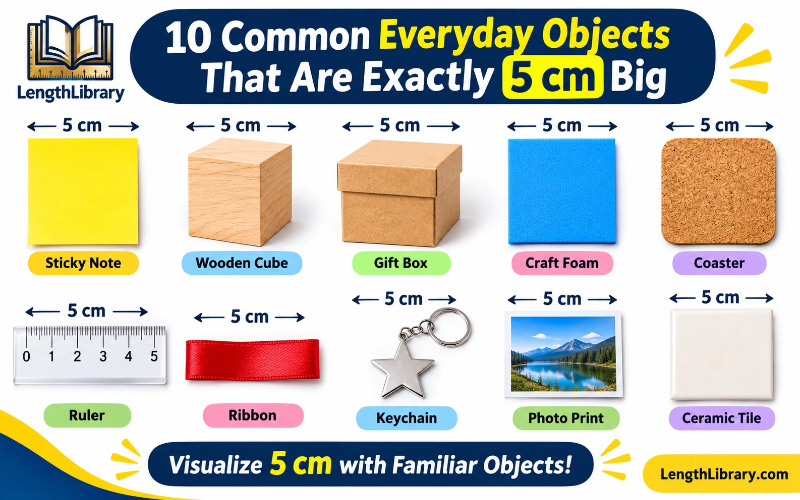
Have you ever wondered how big 5 centimeters really is? Although 5 cm sounds like a small measurement, it becomes much easier to understand when you compare it with familiar objects you use every day. From stationery and household supplies to small accessories and everyday items, several objects have dimensions close to or exactly 5 centimeters.
Five centimeters equals 50 millimeters or approximately 1.97 inches. It is just slightly shorter than 2 inches, making it a convenient measurement to recognize without constantly reaching for a ruler.
Understanding the size of 5 cm can help you estimate measurements when shopping, organizing household items, completing school projects, doing crafts, or measuring small objects.
⚡ Quick Answer: How Big Is 5 cm?
Five centimeters is equal to:
- 50 millimeters (mm)
- 0.05 meters (m)
- 1.9685 inches
- Approximately 2 inches
- 0.164 feet
You can visualize 5 cm by looking at a 50 mm square sticky note, a 50 mm wooden craft cube, or a small object specifically manufactured with a 5 cm dimension.
A useful way to remember this measurement is that 5 cm is almost the same as 2 inches. If you have a metric ruler, the distance between the 0 and 5 cm markings shows exactly how long it is.
📐 Understanding the Size of 5 Centimeters
Before exploring the 10 everyday objects, it helps to understand what 5 cm represents.
A centimeter is a metric unit used to measure relatively small lengths. One centimeter contains 10 millimeters, so five centimeters contain 50 millimeters.
For example, if you place a ruler on a table and measure from the zero mark to the five-centimeter mark, the distance between those two points represents exactly 5 cm.
This measurement is useful for identifying the dimensions of small household objects, stationery, craft materials, accessories, and other products.
Here is a simple conversion table:
| Measurement unit | Equivalent to 5 cm |
| Millimeters | 50 mm |
| Centimeters | 5 cm |
| Meters | 0.05 m |
| Inches | 1.97 inches |
| Feet | 0.164 feet |
| Yards | 0.0547 yards |
This is why many products advertised as approximately 2 inches can help you visualize five centimeters, although they are not necessarily exactly 5 cm.
1. 🟨 A Square Sticky Note
A small square sticky note is one of the easiest ways to understand the size of 5 cm. Manufacturers sell mini sticky notes measuring exactly 50 mm by 50 mm, which means each side measures 5 centimeters.

These notes are common in offices, classrooms, study rooms, and homes. People use them to write reminders, mark important information, leave short messages, and organize their daily activities.
A 5 cm sticky note gives you a clear visual reference because it has two equal sides. Its width and height both measure , creating a perfect square.
Interesting facts about this object:
- It usually consists of lightweight paper.
- It has an adhesive strip along one edge.
- You can use it for reminders, labels, and short notes.
- Different manufacturers offer several colors and paper finishes.
A manufacturer’s product catalogue from UPM lists sticky note cubes with individual sheet dimensions of 50 x 50 mm. This confirms that this is an actual commercially available size rather than just an estimate.
Everyday use: Keep a small stack of 5 cm sticky notes beside your computer, notebook, or study materials. They offer a convenient reference whenever you need to visualize this measurement.
2. 🧊 A Wooden Craft Cube
A wooden craft cube is another excellent example of a 5 cm object. Craft stores sell wooden cubes in different dimensions, including 50 mm varieties.

A 50 mm wooden cube measures 5 cm in length, in width, and in height. Unlike a flat sticky note, this object helps you understand three-dimensional measurements.
Wooden cubes are popular among students, teachers, hobbyists, artists, and people who enjoy DIY projects. They provide a simple shape that you can paint, decorate, stack, or use for educational activities.
How big is a 5 cm wooden cube?
Imagine a small wooden block that fits comfortably in your palm. Its six square faces each measure 5 cm by 5 cm.
You can place a ruler against any edge to check its length. The edge should extend from the zero mark to the 5 cm mark.
A cube also helps explain the difference between length and volume.
Its volume is:
V=555=125cm3
Therefore, a wooden cube measuring 5 cm on every side has a volume of 125 cubic centimeters.
Interesting facts about this object:
- All six faces have identical dimensions.
- It can be made from pine, beech, plywood, or other wood materials.
- It works well for school mathematics activities.
- You can use it for stacking games and craft decorations.
Everyday use: Teachers can use a 5 cm wooden cube to explain volume, surface area, geometry, and three-dimensional shapes. It also makes a useful visual aid for children learning basic measurements.
3. 📦 A Square Cardboard Gift Box
Small cardboard gift boxes are available in many sizes, and some manufacturers produce compact 5 cm cube boxes for packaging jewelry, tiny gifts, craft materials, and decorative items.
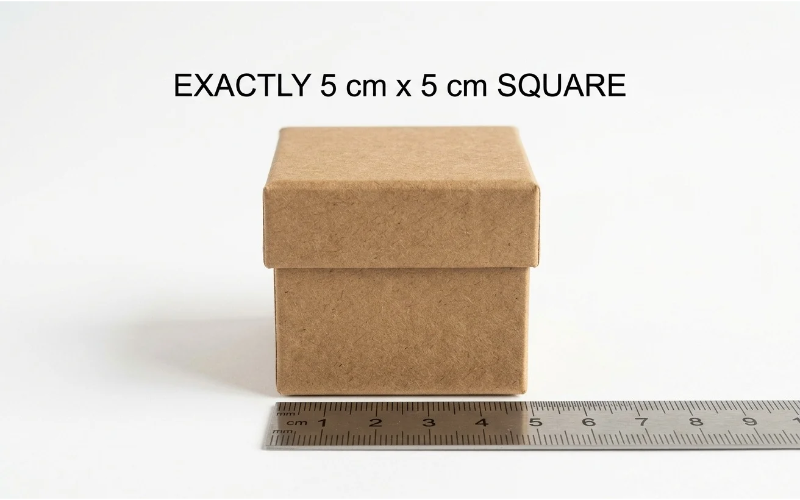
A box measuring 5 x 5 x 5 cm provides another familiar way to understand this measurement.
Its length, width, and height each measure 5 centimeters. This makes it similar in size to the wooden cube, but its hollow interior makes it lighter.
You may find these boxes in gift shops, stationery stores, packaging suppliers, and online marketplaces.
Interesting facts about this object:
- Its exterior dimensions can measure 5 cm on all three sides.
- It is usually made from cardboard or kraft paper.
- It can have a separate lid or folding top.
- It is useful for small gift packaging.
- It can be decorated with ribbons, stickers, or printed designs.
Everyday use: A small 5 cm gift box provides a practical measurement reference when you are wrapping presents or organizing tiny household accessories.
Remember that manufacturers may include the lid in the stated dimensions or list interior dimensions separately. Check the product specifications before treating a particular box as exactly 5 cm.
4. 🧽 A Craft Foam Square
Craft foam is a soft, flexible material used in school projects, decorations, children’s activities, and handmade products.
You can purchase EVA foam sheets and cut them into smaller pieces. A square measuring 50 mm on each side gives you an exact 5 cm reference.
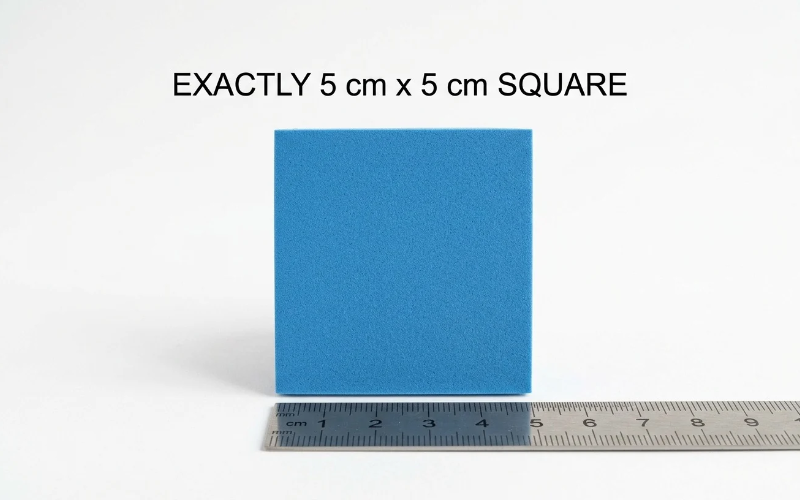
Unlike a wooden cube or cardboard box, this example represents a flat, flexible object. Its thickness may vary considerably, but its length and width can both measure exactly 5 cm.
Craft foam comes in several colors, including red, yellow, blue, green, black, pink, and white. It is easy to cut with suitable scissors or craft tools.
Everyday use: Students can use a 5 cm foam square to make greeting cards, classroom decorations, geometric shapes, and art projects.
It is particularly useful for understanding the difference between a two-dimensional measurement and material thickness.
5. ☕ A Square Drink Coaster
Drink coasters are familiar household accessories that protect tables and desks from moisture, heat, and drink stains.
Although most regular drink coasters are larger than 5 cm, compact decorative and miniature coaster products can be manufactured with a 50 mm width or length.

A small square coaster measuring 5 cm by 5 cm provides a useful example of this measurement.
Coasters can be made from cork, wood, silicone, plastic, rubber, or other materials. Their thickness depends on the design and the level of protection they provide.
Interesting facts about this object:
- It can have a square or rounded design.
- Cork and silicone are popular coaster materials.
- Its surface may contain decorative patterns.
- Some compact versions measure 50 mm across.
- It helps protect furniture from liquid marks.
Everyday use: A compact 5 cm coaster is useful as a miniature desk accessory, decorative piece, or measurement reference.
When purchasing one, check its stated width and length because standard household coasters are commonly available in larger sizes.
6. 📏 A Section of a Small Measuring Ruler
A ruler is probably the most practical object for understanding 5 cm because it displays the measurement directly.
Many small measuring rulers and stationery measuring tools include a clearly marked 5 cm section. You can use this section to compare the length of almost any small household item.

A metric ruler divides each centimeter into 10 smaller millimeter markings. Therefore, the distance between the 0 cm and 5 cm marks contains 50 individual millimeters.
Interesting facts about this object:
- Metric rulers display centimeters and millimeters.
- Each centimeter contains 10 millimeters.
- The 5 cm mark represents 50 mm.
- Rulers are commonly made from plastic, wood, or metal.
- Transparent rulers allow you to see objects underneath them.
Everyday use: Keep a small metric ruler in your pencil case, desk drawer, or school bag. It makes measuring small objects easier and helps you check whether something really measures 5 cm.
One important distinction: a 5 cm section of a ruler is exactly 5 cm long, even if the complete ruler is much longer.
7. 🧵 A Piece of Craft Ribbon
Ribbon is a common household and craft material used for gift wrapping, decorations, clothing accessories, and handmade projects.
You can cut a piece of ribbon to exactly 5 cm using a ruler and scissors. This makes it a convenient example of a flexible object with a measurable length.

Ribbon is available in different materials, widths, and colors. Satin, cotton, polyester, and organza are popular choices.
For this example, the measurement refers to the length of the cut ribbon, not its width.
How does it help you visualize 5 cm?
Cut a piece of ribbon measuring 50 mm from one end to the other. Lay it straight on a flat surface.
Because ribbon bends easily, it is important to lay it flat without stretching or folding it when measuring.
Interesting facts about this object:
- Ribbon comes in many different materials.
- It can have smooth, shiny, or textured surfaces.
- You can cut it to almost any length.
- Its width and length are separate measurements.
- It is useful for decorative and practical purposes.
Everyday use: A 5 cm ribbon piece can help you decorate small gift packages, make bows, create bookmarks, and complete handmade craft projects.
8. 🔑 A Keychain Accessory
Keychains are everyday accessories that help people organize and identify their keys. They come in countless shapes, materials, and designs.
Some keychain pendants are manufactured with a length of 5 cm. These may include small metal tags, decorative charms, miniature souvenirs, and plastic accessories.

A keychain is a useful visual reference because its size is similar to the measurement you might encounter when comparing small personal accessories.
However, keychains do not have a universal 5 cm size. Some are shorter, while others are considerably longer. This example refers specifically to a pendant or accessory with a measured length of 50 mm.
Interesting facts about this object:
- Keychains can be made from metal, plastic, wood, leather, or acrylic.
- Some feature names, logos, or decorative patterns.
- They help distinguish between different sets of keys.
- Small pendants are easy to carry.
- Their dimensions depend on their design.
Everyday use: A 5 cm keychain pendant can serve as a convenient size reference when shopping for small accessories or organizing personal belongings.
For accurate comparisons, measure the pendant itself rather than assuming the entire keychain assembly has the same length.
9. 🖼️ A Mini Photo Print
Photographs come in many shapes and sizes, and miniature photo prints are useful for scrapbooks, journals, handmade cards, and small decorative frames.
A square photograph measuring 5 cm by 5 cm provides another simple way to understand this measurement.
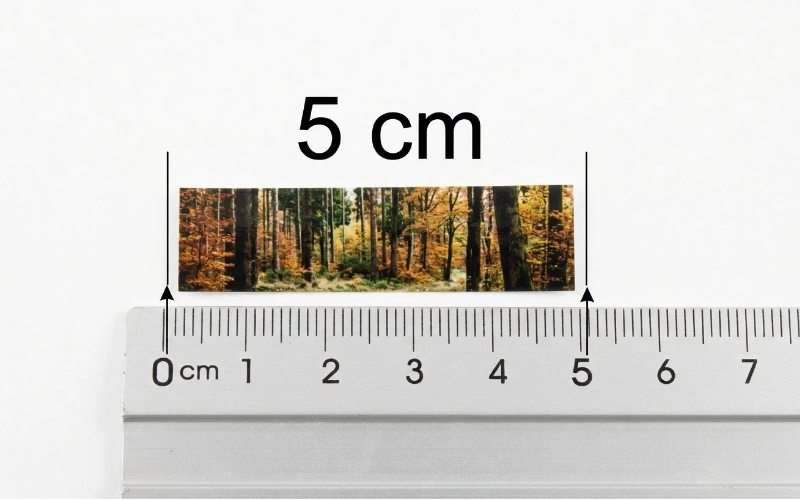
Unlike a standard large photograph, a 5 cm mini print takes up very little space. You can hold it between your fingers and compare its dimensions with a ruler.
The image can show a family photograph, landscape, pet, favorite memory, or any other subject.
How does it help you visualize 5 cm?
Its shape is particularly helpful because both dimensions are identical.
You can also compare its surface area with other square objects.
A=55=25cm2
Therefore, the photograph covers an area of 25 square centimeters.
Interesting facts about this object:
- It can be printed on photographic paper.
- It may have a glossy or matte finish.
- Square prints work well in scrapbooks.
- You can use them for miniature photo frames.
- They are easy to store in small albums.
Everyday use: A 5 cm photograph is suitable for small memory books, handmade gifts, personalized cards, and miniature displays.
10. 🧱 A Square Ceramic Tile Sample
Ceramic tiles are widely used in kitchens, bathrooms, floors, walls, and decorative installations.
Although full-size floor and wall tiles are much larger than it, miniature ceramic tile samples and mosaic tiles can have a side length of exactly 50 mm.

A square tile sample measuring 5 cm by 5 cm is a useful way to understand this measurement because it has a solid, clearly defined shape.
Ceramic tiles come in various colors, patterns, finishes, and thicknesses. You can find glossy white tiles, matte surfaces, textured designs, and decorative mosaic pieces.
How does it help you visualize It?
Take a square tile sample with a 50 mm side. Measure its horizontal edge with a ruler.
The distance should equal exactly 5 centimeters.
Interesting facts about this object:
- Ceramic tiles are generally made from clay-based materials.
- They are available in different finishes.
- Small square tiles are used in mosaic designs.
- Their thickness varies by manufacturer.
- They provide a rigid and easy-to-measure reference.
Everyday use: A 5 cm ceramic tile sample can help you compare colors and finishes when planning small decorative projects, mosaic patterns, or home improvements.
When selecting a tile, check whether the manufacturer lists its actual dimensions or nominal size. These measurements may differ slightly because of manufacturing tolerances.
📊 Comparison Table: 10 Objects That Help You Visualize 5 cm
Here is a quick comparison of the objects discussed above.
| Everyday object | Measurement representing 5 cm |
| Square sticky note | Each side: 5 cm |
| Wooden craft cube | Each edge: 5 cm |
| Cardboard gift box | Length, width, and height: 5 cm |
| Craft foam square | Each side: 5 cm |
| Square drink coaster | Each side: 5 cm |
| Measuring ruler | Section from 0 to 5 cm |
| Craft ribbon | Cut length: 5 cm |
| Keychain accessory | Pendant length: 5 cm |
| Mini photo print | Width and height: 5 cm |
| Ceramic tile sample | Each side: 5 cm |
The table describes specific 5 cm sizes or measured sections. It does not mean every product in each category has these dimensions.
🔍 How to Measure 5 cm Accurately at Home
You do not need specialized equipment to measure five centimeters. A simple metric ruler is enough for most everyday objects.
Follow these steps:
- Place the object on a flat surface.
- Position the zero mark of your ruler at one end.
- Keep the ruler straight along the dimension you want to measure.
- Locate the marking.
- Check whether the other end of the object lines up with that mark.
If the object has an irregular shape, measure its longest straight dimension or use a flexible measuring tape where appropriate.
Understanding Millimeter Markings
Most metric rulers divide every centimeter into 10 equal sections.
Each small section represents 1 mm.
Therefore:
- 10 mm = 1 cm
- 20 mm = 2 cm
- 30 mm = 3 cm
- 40 mm = 4 cm
- 50 mm = 5 cm
This simple relationship makes it easier to recognize five centimeters without performing complicated calculations.
Common Measuring Mistakes to Avoid
Even a small measurement can become inaccurate if you use the wrong measuring technique.
Here are some common mistakes:
- Starting from the physical edge of a ruler instead of its zero mark.
- Measuring a curved object along a straight line without considering its shape.
- Confusing width with length.
- Including packaging when you only need the object’s dimensions.
- Assuming a product advertised as 2 inches measures exactly 5 cm.
For accurate results, always check the manufacturer’s specifications or measure the actual object.
📚 Why Is It Useful to Know What 5 cm Looks Like?
Knowing the approximate size of five centimeters can make several everyday activities easier. You may not always have a ruler nearby, but familiar objects can help you estimate small measurements.
Here are some practical situations where understanding it becomes useful.
1. Shopping for Small Household Items
When shopping online, product descriptions often include measurements in centimeters or millimeters.
Understanding 5 cm helps you decide whether a small accessory, storage box, decorative item, or stationery product will fit your requirements.
For example, if you want a small square box measuring 5 cm on each side, you can compare the listed dimensions with the examples in this article.
2. Completing School and Mathematics Projects
Five centimeters is a useful measurement for geometry, drawing, and craft assignments.
Students can use this length to draw squares, construct rectangles, measure shapes, and understand the relationship between centimeters and millimeters.
A 5 cm wooden cube is particularly useful for demonstrating volume and surface area.
3. Making Handmade Decorations
Craft projects often involve cutting paper, ribbon, foam, and other materials into specific sizes.
For example, you can prepare five-centimeter squares for greeting cards, scrapbook decorations, and small handmade gifts.
4. Organizing Small Accessories
Small objects often need separate storage spaces. Understanding their dimensions helps you select suitable containers, compartments, and organizers.
A 5 cm reference can help when arranging jewelry, stationery, buttons, beads, and other accessories.
5. Estimating Measurements Without a Ruler
You can develop a better understanding of measurements by comparing familiar objects with a known length.
For example, once you become familiar with a 50 mm sticky note, you may find it easier to estimate other small objects.
However, visual estimation is not a substitute for accurate measurement. If a project requires precision, use a ruler or measuring tape.
🧮 Mathematical Facts About 5 cm
Five centimeters is a useful measurement for learning several basic mathematical concepts.
5 cm in Inches
To convert centimeters into inches, multiply the measurement by 0.393701.
50.393701=1.968505
Therefore, 5 cm is approximately 1.97 inches.
It is very close to 2 inches, but remember that 2 inches equals 5.08 cm.
5 cm in Millimeters
One centimeter equals 10 millimeters.
Therefore:
510=50mm
Five centimeters equals exactly 50 millimeters.
Area of a 5 cm Square
If you draw a square with four equal sides measuring 5 cm, its area is:
A=s2
A=55=25cm2
The total area is 25 square centimeters.
Perimeter of a 5 cm Square
A square has four equal sides.
Its perimeter is:
P=4s
P=45=20cm
Therefore, a square measuring 5 cm on each side has a perimeter of 20 cm.
Volume of a 5 cm Cube
A cube has three dimensions: length, width, and height.
When each dimension measures 5 cm:
V=lwh
V=555=125cm3
Its volume is 125 cubic centimeters.
These calculations show that a simple 5 cm measurement can help explain length, area, perimeter, and volume.
🌟 Simple Ways to Remember the Size of 5 cm
If you want to remember five centimeters without constantly checking a ruler, try these methods.
Remember the 50 mm Conversion
The easiest way to remember 5 cm is to associate it with 50 mm.
Whenever you see a product measuring 50 mm, you immediately know that it is 5 centimeters long or wide.
Think About a Small Square Sticky Note
A 50 x 50 mm sticky note is an especially useful visual reference. Its equal sides make the measurement easy to recognize.
You can keep one on your desk and use it whenever you need a quick comparison.
Compare It With 2 Inches
Five centimeters is just a little shorter than two inches.
This comparison is helpful if you are more familiar with imperial measurements.
Remember that the difference is 0.08 cm, or 0.8 mm.
Use Your Own Measuring Reference
Choose a small object that you have measured accurately. Remember its dimensions and use it as a reference when estimating similar lengths.
Avoid assuming that every similar-looking object has identical dimensions.
📋 BioWiki: Understanding 5 Centimeters
The following BioWiki table summarizes the important facts about the measurement.
| BioWiki detail | Information |
| Measurement | 5 centimeters |
| Symbol | 5 cm |
| Measurement system | Metric system |
| Equivalent in millimeters | 50 mm |
| Equivalent in meters | 0.05 m |
| Equivalent in inches | 1.9685 inches |
| Approximate imperial comparison | Almost 2 inches |
| Measurement category | Length |
| Square area with 5 cm sides | 25 cm² |
| Perimeter of a 5 cm square | 20 cm |
| Volume of a 5 cm cube | 125 cm³ |
| Common applications | Crafts, stationery, packaging, education, and household measurements |
| Measuring instrument | Metric ruler or measuring tape |
| Best visual reference | 50 x 50 mm square sticky note |
❓ Frequently Asked Questions About 5 cm
Here are answers to common questions about the size of five centimeters and everyday objects that can help you visualize it.
1. How big is 5 cm in inches?
Five centimeters equals approximately 1.97 inches. It is slightly shorter than 2 inches, which equals 5.08 centimeters.
2. Is 5 cm considered big or small?
Five centimeters is generally considered a small measurement. It is useful for measuring stationery, accessories, craft materials, and other compact household objects.
However, whether it is big or small depends on the object you are measuring.
3. What everyday object is exactly 5 cm long?
A 50 mm measuring section on a ruler is exactly 5 cm long. Other examples include a 50 mm ribbon piece and a square sticky note measuring 50 x 50 mm.
4. Is 50 mm the same as 5 cm?
Yes. Fifty millimeters equals exactly five centimeters because every centimeter contains 10 millimeters.
5. Is 2 inches exactly 5 cm?
No. Two inches equals 5.08 cm. It is only 0.08 cm longer than five centimeters.
6. How can I measure 5 cm without a ruler?
You can use an object with a verified 50 mm dimension as a reference, such as a 5 cm square sticky note. However, this method is only suitable for rough comparisons. Use a ruler when accuracy matters.
7. How many millimeters are in 5 centimeters?
There are 50 millimeters in five centimeters.
8. Can a sticky note measure exactly 5 cm?
Yes. Some manufacturers produce square sticky notes measuring 50 x 50 mm. Each note is exactly 5 cm wide and 5 cm tall according to its specified dimensions.
9. What is the area of a square measuring 5 cm?
The area is 25 square centimeters. You calculate it by multiplying the length of one side by itself: 5 x 5 = 25 cm².
10. What is the perimeter of a 5 cm square?
The perimeter is 20 cm because a square has four equal sides. Multiply 5 cm by four to get the total perimeter.
11. What is the volume of a cube measuring 5 cm on each side?
The volume is 125 cubic centimeters. Multiply its length, width, and height: 5 x 5 x 5 = 125 cm³.
12. Is a 5 cm object the same as a 50 mm object?
Yes. Both measurements describe the same length. Five centimeters and 50 millimeters are interchangeable measurements.
13. What is the easiest way to visualize 5 cm?
A square sticky note measuring 50 x 50 mm is one of the easiest references. Its width and height both measure five centimeters, making the size simple to understand.
14. Are all keychains approximately 5 cm long?
No. Keychains come in many different sizes. Some pendants measure 5 cm, while others are shorter or longer. You should check the manufacturer’s measurements before using one as a reference.
15. Why should I learn to recognize 5 cm?
Recognizing five centimeters makes it easier to estimate small dimensions, compare products, complete craft projects, understand school measurements, and organize household items.
More Measurement Guides
- 10 Common Everyday Objects That Are Exactly 4 cm Big
- 10 Common Everyday Objects That Are Exactly 3 cm Big
- 10 Common Everyday Objects That Are Exactly 2 cm Big
- 10 Common Everyday Objects That Are Exactly 1 cm Big
🎯 Conclusion
Understanding how big 5 cm is becomes much easier when you compare it with familiar everyday objects. Although five centimeters is a relatively small measurement, it appears in many products and materials used at home, school, and work.
Remember that five centimeters equals 50 millimeters or approximately 1.97 inches. It is almost the same as two inches, making it easy to remember.
The most important thing is to identify which dimension measures 5 cm. An object’s width, height, length, and thickness can all be different.
📏 Keep Exploring Measurements
Discover more practical guides about everyday lengths, measurements, conversions, and useful size references.