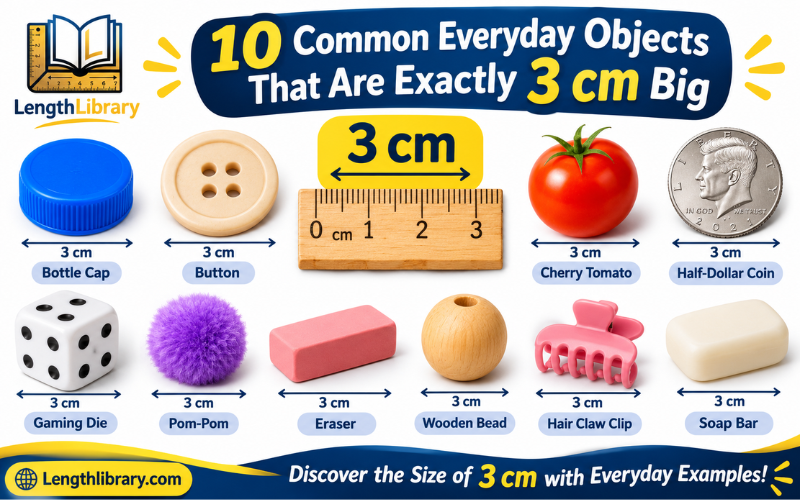
Have you ever wondered how big 3 centimeters really is? Although it sounds like a very small measurement, 3 cm is surprisingly easy to recognize when you compare it with familiar everyday objects. From bottle caps and large buttons to small tomatoes and coins, several ordinary items can help you understand this measurement without reaching for a ruler.
Three centimeters equals 30 millimeters or approximately 1.18 inches. It is slightly longer than one inch, making it a useful measurement for understanding the size of small household items, stationery, accessories, and food products.
Knowing what 3 cm looks like can also help when measuring objects for school projects, shopping online, crafting, DIY activities, or checking the dimensions of small products.
In this article, we explore 10 common everyday objects that measure approximately 3 cm in one dimension. Each example includes a description, measurement comparison, and practical way to recognize its size.
An important measurement note: Everyday products do not all follow identical manufacturing dimensions. Some examples below have standard or commonly available sizes close to 30 mm, while others vary by brand, design, and manufacturer. Therefore, we distinguish approximate comparisons from exact measurements rather than suggesting that every bottle cap, tomato, or button measures precisely 3 cm.
⚡ Quick Answer: How Big Is 3 cm?
3 centimeters is equal to:
- 30 millimeters (mm)
- 0.03 meters (m)
- 1.181 inches (in)
- 0.0984 feet (ft)
- Approximately 1 and 3/16 inches
A 3 cm measurement is approximately the diameter of a large bottle cap, the width of a large button, or the diameter of a small cherry tomato. These objects provide useful visual comparisons, although their actual dimensions can vary.
If you want to recognize 3 cm quickly, remember this simple comparison: 30 mm is a little longer than the width of your thumb.
📐 Understanding the Size of 3 Centimeters
Before comparing everyday objects, it helps to understand what a centimeter represents.
A centimeter is a metric unit of length. It is one-hundredth of a meter and contains 10 millimeters. The metric system uses centimeters for measuring relatively small objects, including stationery, household accessories, food items, and personal belongings.
For example, a pencil’s width, a button’s diameter, or the thickness of a small notebook can be measured in centimeters.
Three centimeters is not particularly large, but it is big enough to notice without using a magnifying glass. You can hold an object of this size between your fingers, compare it with your thumb, or place it against a ruler.
Here are some useful conversions:
| Measurement unit | Equivalent |
| Centimeters | 3 cm |
| Millimeters | 30 mm |
| Meters | 0.03 m |
| Inches | 1.181 in |
| Feet | 0.0984 ft |
| Yards | 0.0328 yd |
These conversions are especially useful when shopping for products that list their dimensions in inches rather than centimeters.
1. A Standard Bottle Cap 🧴
A plastic bottle cap is one of the easiest household objects to use when imagining a measurement close to 3 cm. Many beverage bottle caps have diameters around 28 to 30 millimeters, depending on the bottle’s neck finish and manufacturer.

If you take a cap from a common soft drink or water bottle, you may find that its diameter comes very close to 3 centimeters.
How does a bottle cap compare with 3 cm?
The diameter is the distance from one side of the circular cap to the opposite side, measured through its center.
A cap measuring 30 mm across has an exact diameter of 3 cm. However, many ordinary beverage caps are slightly smaller, so you should not assume every cap measures exactly 30 mm.
The height of the cap is another measurement entirely. Most standard plastic bottle caps are considerably shorter than their diameter.
Where can you find this object?
You can find plastic bottle caps on:
- Drinking water bottles
- Soft drink bottles
- Juice bottles
- Some household cleaning containers
- Reusable plastic beverage containers
Why is it a useful comparison?
Bottle caps are easy to find in kitchens, offices, classrooms, and shops. Their circular shape also makes it simple to understand diameter.
If you need a quick visual reference for 3 cm, place a bottle cap beside a metric ruler and measure across its widest point.
2. A Large Shirt Button 👔
A large shirt button can provide another helpful comparison for understanding 3 centimeters.
Buttons come in many shapes and sizes. Small shirt buttons may measure less than 1 cm, while large decorative buttons and coat buttons can measure around 3 cm in diameter.

A button with a diameter of exactly 30 mm provides a direct example of a 3 cm object.
How does a large button measure 3 cm?
Button size usually refers to its diameter, particularly when the button has a circular shape.
For example:
- Small buttons may measure 10 to 15 mm.
- Medium buttons may measure 15 to 25 mm.
- Large buttons may measure around 30 mm or more.
These are general size descriptions rather than universal manufacturing standards.
A 30 mm button measures exactly 3 cm from one outer edge to the opposite outer edge.
Where can you find large buttons?
You may find buttons of this size on:
- Winter coats
- Decorative jackets
- Cardigans
- Handmade clothing
- Craft projects
- Fashion accessories
Why is it a useful comparison?
A large button is a practical measurement reference because you can easily hold it, examine its circular shape, and measure its diameter.
If you have a button collection at home, look for one measuring approximately 3 cm across. It can help children understand centimeters through a simple household activity.
3. A Small Cherry Tomato 🍅
A small cherry tomato is another familiar object that can help you visualize a measurement close to 3 cm.
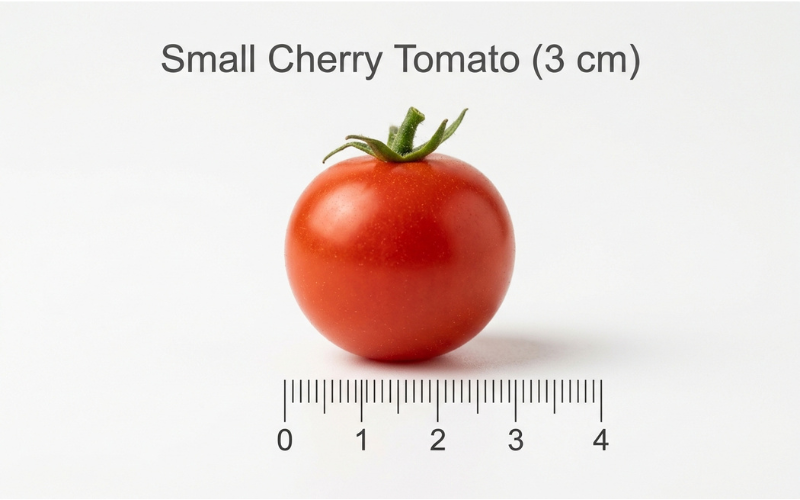
Cherry tomatoes are generally smaller than regular tomatoes. Depending on the variety and growing conditions, some measure approximately 2 to 3.5 cm in diameter.
A cherry tomato measuring 30 mm across provides a particularly useful comparison.
How does a cherry tomato compare with 3 cm?
Imagine placing a small cherry tomato on a flat surface and measuring its widest section.
If the measurement reaches 30 mm, its diameter is exactly 3 cm.
However, tomatoes are natural products, so their dimensions vary. Some cherry tomatoes are smaller, while larger varieties can exceed this measurement.
Their slightly rounded shape also means that measuring from the widest point gives a more useful comparison than measuring their height.
Where can you find cherry tomatoes?
You can find them in:
- Grocery stores
- Supermarkets
- Vegetable markets
- Home gardens
- Salad containers
- Kitchen refrigerators
Why is it a useful comparison?
A cherry tomato makes the measurement easier to understand because most people recognize its size.
It also provides an opportunity to introduce practical measurement activities to children. Ask them to select a cherry tomato, estimate its diameter, and then check the measurement with a ruler.
This simple activity connects mathematics with everyday life.
4. A Large U.S. Half-Dollar Coin 🪙
Coins are excellent measurement references because mints manufacture them according to specific dimensions. A particularly interesting example is the United States half-dollar coin.
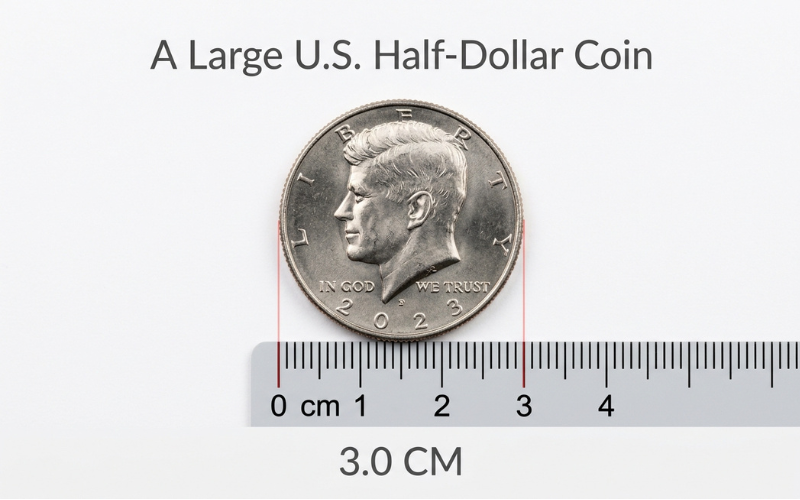
The modern U.S. half-dollar coin has a diameter of 30.61 mm, which is approximately 3.06 cm. This makes it slightly larger than the 3 cm measurement.
How does a half-dollar coin compare with 3 cm?
The coin measures approximately 3.06 cm from one edge to the opposite edge. The difference between its diameter and 3 cm is only 0.61 mm.
That small difference makes it a useful real-world comparison when you want to visualize a measurement of 3 cm.
According to the United States Mint, the coin has these specifications:
| Feature | Measurement |
| Diameter | 30.61 mm |
| Diameter in centimeters | 3.061 cm |
| Thickness | 2.15 mm |
| Weight | 11.34 g |
U.S. Mint+1
Where can you find this object?
You can find half-dollar coins through:
- Coin collectors
- Coin dealers
- American currency collections
- Numismatic exhibitions
- U.S. currency collections
Why is it a useful comparison?
Unlike naturally grown food or ordinary household products, coins have published specifications. This makes them particularly useful for learning about standardized measurements.
Although the half-dollar is not exactly 3 cm, its 30.61 mm diameter gives you an excellent visual reference.
5. A Large Gaming Die 🎲
A traditional gaming die is a familiar object used in board games, classroom activities, and recreational games. Most standard dice are smaller than 3 cm, but larger gaming dice are available in 30 mm sizes.

A 30 mm die measures exactly 3 cm along each edge if it has a perfectly cubic shape.
How does a gaming die measure 3 cm?
A cube has six equal square faces and twelve equal edges.
For a 30 mm gaming die:
- Length: 30 mm
- Width: 30 mm
- Height: 30 mm
All three dimensions equal 3 cm.
This makes a large gaming die one of the most straightforward examples of an object that can measure exactly 3 cm in every direction.
Where can you find large gaming dice?
You may find them in:
- Board game stores
- Educational mathematics kits
- Tabletop gaming collections
- Casino-style gaming accessories
- Classroom teaching materials
Why is it a useful comparison?
A gaming die offers something that many other objects cannot: three equal dimensions.
You can use it to explain length, width, height, edges, faces, and volume.
For example, the volume of a 3 cm cube is:
V=333=27cm3
This makes a 30 mm die a useful teaching aid for introducing three-dimensional geometry.
Remember that ordinary dice often measure around 16 to 20 mm, so check the product specifications when choosing a 30 mm version.
6. A Small Craft Pom-Pom 🧶
Craft pom-poms are small, fluffy decorative balls commonly used in school projects, handmade decorations, and children’s artwork.

They are available in different diameters, including 10 mm, 15 mm, 20 mm, 25 mm, 30 mm, and larger sizes.
A 30 mm craft pom-pom is exactly 3 cm in diameter.
How does a pom-pom compare with 3 cm?
The diameter measures the distance across the widest part of the round pom-pom.
If you select a 30 mm pom-pom, it will measure 3 cm across when gently measured without compressing its fibers.
Because pom-poms consist of soft yarn or synthetic fibers, pressing them can change their apparent dimensions.
For a more accurate measurement, measure the widest distance without squeezing the material.
Where can you find craft pom-poms?
They are commonly available in:
- Stationery shops
- Arts and crafts stores
- School project kits
- Online craft marketplaces
- Children’s activity collections
Why is it a useful comparison?
A 3 cm pom-pom provides an easy way to understand the size of a small sphere.
Children can use different colored pom-poms to compare 1 cm, 2 cm, and 3 cm measurements.
Teachers can also use them to demonstrate how diameter differs from circumference.
For example, a spherical pom-pom with a diameter of 3 cm has a circumference of approximately:
C=d
C=3.14163
C9.42cm
This makes a simple craft supply useful for both measurement practice and basic geometry.
7. A Small Rectangular Eraser ✏️
An eraser is one of the most recognizable stationery items in homes, schools, and offices.
Although many full-size erasers are longer than 3 cm, small rectangular erasers are commonly available in compact sizes. Some measure approximately 30 mm along their shortest or longest side.

A small eraser measuring 30 mm in length provides an easy comparison for understanding 3 cm.
How does an eraser measure 3 cm?
Erasers come in different shapes, including rectangular, square, oval, and cylindrical designs.
Consider a small rectangular eraser with these dimensions:
| Dimension | Example measurement |
| Length | 30 mm |
| Width | 15 mm |
| Height | 10 mm |
Its length is exactly 3 cm.
The other dimensions are smaller, which demonstrates why it is important to specify which side of an object you are measuring.
Where can you find this object?
You can find small erasers in:
- School stationery sets
- Pencil cases
- Office supply stores
- Art and drawing kits
- Children’s writing materials
Why is it a useful comparison?
An eraser is easy to handle and measure. Its rectangular shape also makes it suitable for demonstrating the difference between length, width, and height.
For children learning the metric system, measuring an eraser is a simple activity that requires only a ruler and an ordinary stationery item.
You can also compare several erasers of different sizes and identify which one comes closest to 3 cm.
8. A Wooden Craft Bead 🟤
Wooden craft beads are commonly used in jewelry making, decorative projects, handmade accessories, and school activities.

They are available in different sizes, and 30 mm wooden beads are a popular option for larger decorative designs.
A spherical wooden bead with a diameter of 30 mm measures exactly 3 cm across.
How does a wooden bead compare with 3 cm?
The measurement refers to the bead’s diameter rather than its circumference.
If you measure from one outer edge through the center to the opposite edge, a 30 mm bead gives you the required 3 cm measurement.
Some wooden beads also contain a small hole through the center for threading. This opening does not change the bead’s external diameter.
Where can you find wooden beads?
You can find them in:
- Craft supply shops
- Jewelry-making kits
- Handmade decoration collections
- DIY project stores
- Online arts and crafts retailers
Why is it a useful comparison?
A wooden bead offers a clear example of a small spherical object.
Unlike a soft pom-pom, a wooden bead maintains its shape when you handle it. This makes it easier to measure accurately.
It can also help explain the difference between the diameter and radius of a sphere.
For a bead measuring 3 cm across:
r=d2
r=32=1.5cm
Therefore, the radius is 1.5 cm, while the full diameter is 3 cm.
9. A Mini Hair Claw Clip 💇♀️
Mini hair claw clips are small accessories used to hold sections of hair in place. They are available in numerous colors, shapes, and designs.
Some miniature claw clips measure approximately 3 cm in their overall length or width.
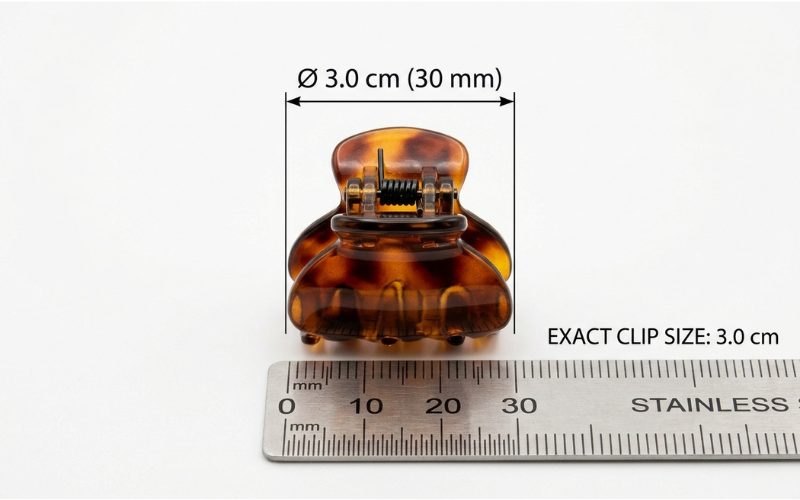
Their compact size makes them a useful example of an everyday accessory that can help you visualize a measurement close to 3 cm.
How does a mini hair clip compare with 3 cm?
A small hair clip may have an overall length of approximately 30 mm, although the dimensions vary considerably between manufacturers.
When measuring a clip, keep it closed and measure from its outermost point to the opposite outermost point.
Do not confuse the length of the clip with the distance between its teeth. The teeth may occupy only a portion of its overall length.
Where can you find mini hair clips?
These accessories are commonly available in:
- Beauty supply stores
- Supermarkets
- Hair accessory shops
- Cosmetic stores
- Personal grooming kits
Why is it a useful comparison?
Mini hair clips are lightweight, portable, and easy to recognize.
They also demonstrate an important measurement concept: two objects can have similar lengths but completely different shapes and functions.
A 3 cm hair clip is useful as a visual reference, but you should measure the individual accessory because not all mini clips share the same dimensions.
10. A Small Rectangular Soap Bar 🧼
Small soap bars are commonly found in bathrooms, hotels, travel kits, and guest accommodation.

While most full-size soap bars measure considerably more than 3 cm in their overall length, some compact travel soaps have a thickness or width close to 30 mm.
A small rectangular soap bar with one side measuring exactly 30 mm provides another practical comparison.
How does a small soap bar measure 3 cm?
Soap bars have three main dimensions:
- Length
- Width
- Thickness
A compact soap bar might have dimensions such as:
| Dimension | Example measurement |
| Length | 60 mm |
| Width | 30 mm |
| Thickness | 20 mm |
In this example, the width is exactly 3 cm.
The example demonstrates that an object does not need to be 3 cm long on every side to qualify as a 3 cm comparison. One of its dimensions can provide the reference.
Where can you find small soap bars?
You can find them in:
- Hotel bathroom kits
- Travel toiletry sets
- Guest bathrooms
- Supermarkets
- Personal hygiene product collections
Why is it a useful comparison?
Soap bars have relatively flat surfaces and straight edges, making their dimensions easy to measure.
You can place a small soap bar on a table and use a ruler to check its length, width, and thickness.
This makes it a convenient household example for explaining how manufacturers describe the dimensions of rectangular products.
📊 BioWiki Reference Table: 10 Everyday Objects Around 3 cm
The following table summarizes the objects discussed above, their relevant dimensions, and how closely they compare with 3 cm.
| Everyday object | Dimension to measure | Approximate or specified size |
| Plastic bottle cap | Diameter | 28–30 mm |
| Large shirt button | Diameter | 30 mm |
| Small cherry tomato | Diameter | 25–35 mm |
| U.S. half-dollar coin | Diameter | 30.61 mm |
| Large gaming die | Edge length | 30 mm |
| Craft pom-pom | Diameter | 30 mm |
| Small rectangular eraser | Length | 30 mm |
| Wooden craft bead | Diameter | 30 mm |
| Mini hair claw clip | Overall length or width | Around 30 mm |
| Small rectangular soap bar | Width or thickness | Around 30 mm |
BioWiki note: These are reference dimensions, not universal specifications for every product. The 30 mm examples represent selected sizes available in the relevant product categories. Natural objects and manufactured accessories can vary.
🔍 How to Measure 3 cm Correctly
Understanding a measurement becomes much easier when you know how to use a ruler correctly.
If you want to confirm whether an object measures exactly 3 cm, follow these simple steps.
Step 1: Choose a metric ruler
Use a ruler that displays centimeters and millimeters.
Most metric rulers have centimeter markings numbered from 0 onward, with smaller millimeter divisions between them.
One centimeter contains 10 millimeters.
Step 2: Place the object at the zero mark
Position one edge of the object directly above the zero mark.
Avoid starting at the physical end of the ruler because some rulers have a small gap before the first measurement marking.
Step 3: Identify the opposite edge
Look at the measurement marking that aligns with the opposite edge of the object.
If the object ends at the 3 cm mark, its measured dimension is 3 centimeters.
Step 4: Check the measurement twice
Small measurement errors can occur when an object has curved edges, soft surfaces, or an irregular shape.
Repeat the measurement to confirm your result.
Step 5: Measure the correct dimension
Remember that length, width, height, diameter, and thickness describe different measurements.
For example, a bottle cap may have a diameter of 3 cm but a height of only 1 cm.
Always identify the dimension before comparing an object with the 3 cm reference.
🧠 Easy Ways to Visualize 3 cm Without a Ruler
You do not always need a measuring instrument to estimate a small distance. Familiar objects and body measurements can provide quick references.
Here are some practical methods.
Compare it with your thumb
The width of an adult thumb often measures around 2 to 3 cm, although individual hand sizes vary.
Look at the widest part of your thumb and compare it with a 3 cm measurement.
This method provides a rough estimate rather than an accurate measurement.
Compare it with a large bottle cap
A large bottle cap may measure close to 3 cm across.
Place it on a flat surface and compare its diameter with the length you want to estimate.
Use a large button
A large decorative button measuring 30 mm provides an excellent reference.
You can keep one in a sewing kit or stationery drawer for quick comparisons.
Use a 30 mm gaming die
A large gaming die is particularly useful because its length, width, and height can all measure 3 cm.
Unlike a flat object, it helps you visualize a three-dimensional measurement.
Remember the inch conversion
Three centimeters equal approximately 1.18 inches.
This means 3 cm is slightly longer than one inch.
If you are familiar with inches, this comparison can help you estimate the measurement without converting it every time.
📚 Why Is Knowing the Size of 3 cm Useful?
A small measurement such as 3 cm may seem unimportant, but it has many practical applications.
Understanding this dimension can help with schoolwork, shopping, crafts, home organization, and product comparisons.
1. Mathematics and school assignments
Students frequently encounter centimeters when learning measurement, geometry, and unit conversion.
Comparing 3 cm with familiar objects makes mathematical concepts easier to understand.
For example, a teacher can ask students to identify five classroom objects measuring approximately 3 cm in one dimension.
Students can estimate their sizes and then verify their answers with rulers.
2. Arts and crafts
Craft projects often require accurate measurements.
You might need a 3 cm bead, a 30 mm decorative button, or a small piece of cardboard with a specific width.
Understanding this measurement helps you select suitable materials and avoid cutting pieces that are too large or too small.
3. Online shopping
Many online stores list product dimensions in millimeters or centimeters.
A seller might describe an accessory as 30 mm wide.
Knowing that 30 mm equals 3 cm helps you understand the product’s actual size before purchasing it.
This is particularly useful when buying small accessories, stationery, jewelry-making supplies, and decorative items.
4. DIY and home improvement
Small household projects sometimes require precise measurements.
For example, you might need to check the width of a small fitting, the thickness of a decorative piece, or the dimensions of a replacement component.
Knowing how to recognize 3 cm can make these tasks easier.
5. Teaching children about measurement
Children often understand measurements better when they can see and touch real objects.
Instead of explaining centimeters only through numbers, parents and teachers can use bottle caps, buttons, erasers, and large dice.
This approach connects mathematics with familiar experiences.
🔬 Interesting Facts About 3 Centimeters
Here are several interesting facts that make this small measurement easier to remember.
3 cm equals 30 millimeters
The relationship between centimeters and millimeters is straightforward.
310=30mm
Every centimeter contains 10 millimeters, so three centimeters contain 30.
3 cm is slightly longer than one inch
One inch equals 2.54 cm.
Therefore, 3 cm is 0.46 cm longer than one inch.
3-2.54=0.46cm
This difference is small but noticeable when you compare the two measurements with a ruler.
A 3 cm cube has a volume of 27 cubic centimeters
If an object has equal length, width, and height of 3 cm, it forms a cube.
Its volume is:
V=lwh
V=333=27cm3
This is a useful example of how a simple length measurement connects to three-dimensional geometry.
A circle with a 3 cm diameter has a radius of 1.5 cm
The radius represents half the diameter.
r=32=1.5cm
This relationship is useful when measuring circular objects such as bottle caps, buttons, and beads.
A 3 cm circle has a circumference of approximately 9.42 cm
The circumference is the distance around a circle.
Using the formula:
C=d
For a circle with a diameter of 3 cm:
C=3.14163
C9.42cm
This calculation shows why diameter and circumference should never be confused when measuring round objects.
❓ Frequently Asked Questions About 3 cm
1. How big is 3 cm in inches?
Three centimeters equals approximately 1.18 inches. It is slightly longer than one inch and provides a useful reference when comparing small household objects.
2. Is 3 cm the same as 30 mm?
Yes. One centimeter contains 10 millimeters, so 3 centimeters equal exactly 30 millimeters.
3. What common household object is exactly 3 cm long?
A large 30 mm gaming die, a 30 mm wooden craft bead, or a 30 mm decorative button can provide exact 3 cm examples. However, you should check the manufacturer’s specifications before relying on a particular product’s dimensions.
4. Is a bottle cap 3 cm wide?
Many plastic beverage bottle caps measure approximately 28 to 30 mm in diameter. Some reach 30 mm, but others are slightly smaller. The actual measurement depends on the bottle and cap design.
5. How can I measure 3 cm without a ruler?
You can estimate 3 cm by comparing it with a large bottle cap, a decorative button, or the width of your thumb. These comparisons are helpful for estimating size, but they cannot replace an accurate ruler measurement.
6. Is 3 cm bigger than an inch?
Yes. One inch equals 2.54 cm, while 3 cm equals approximately 1.18 inches. Therefore, 3 cm is 0.46 cm longer than one inch.
7. What does a 3 cm cube look like?
A 3 cm cube has equal length, width, and height. Each edge measures 30 mm, and its total volume is 27 cubic centimeters.
8. How many millimeters are there in 3 cm?
There are exactly 30 millimeters in 3 centimeters. To convert centimeters into millimeters, multiply the centimeter measurement by 10.
9. Is a cherry tomato exactly 3 cm wide?
Some cherry tomatoes measure approximately 3 cm in diameter, but their sizes vary according to variety, growing conditions, and maturity. You should measure an individual tomato to determine its actual diameter.
10. What is the easiest object to use as a 3 cm reference?
A 30 mm gaming die is one of the easiest options because all its edges measure 3 cm. A wooden craft bead with a specified 30 mm diameter is another useful reference.
11. How do I measure the diameter of a circular object?
Place the circular object on a flat surface and measure across its widest point, passing through the center. This distance represents its diameter.
12. Why is it important to know the difference between length and diameter?
Length measures the distance between two endpoints along a particular direction, while diameter measures the distance across a circle through its center. Understanding the difference prevents measurement mistakes when comparing round and rectangular objects.
More Measurement Guides
- 10 Common Everyday Objects That Are Exactly 2 cm Big
- 10 Common Everyday Objects That Are Exactly 1 cm Big
- 10 Common Everyday Objects That Are Exactly 250 Feet Long
- 10 Common Everyday Objects That Are Exactly 200 Feet Long
🎯 Conclusion: Recognizing 3 cm in Everyday Life
Three centimeters is a small but useful measurement that appears in many everyday products and household items. Although it may seem difficult to visualize initially, comparing it with familiar objects makes the measurement much easier to understand.
A large bottle cap, decorative button, small cherry tomato, gaming die, wooden bead, and compact stationery item can all provide useful references for recognizing a size close to 3 cm.
Among these examples, a 30 mm gaming die and a 30 mm wooden craft bead are particularly helpful because their specified dimensions can match 3 cm exactly. Other objects, such as bottle caps and natural tomatoes, offer approximate comparisons because their sizes vary.
Remember that 3 cm equals 30 mm or approximately 1.18 inches. Keep this conversion in mind whenever you measure small objects, shop online, complete DIY projects, or help children learn mathematics
📏 Keep Exploring Measurements
Discover more practical guides about everyday lengths, measurements, conversions, and useful size references.