
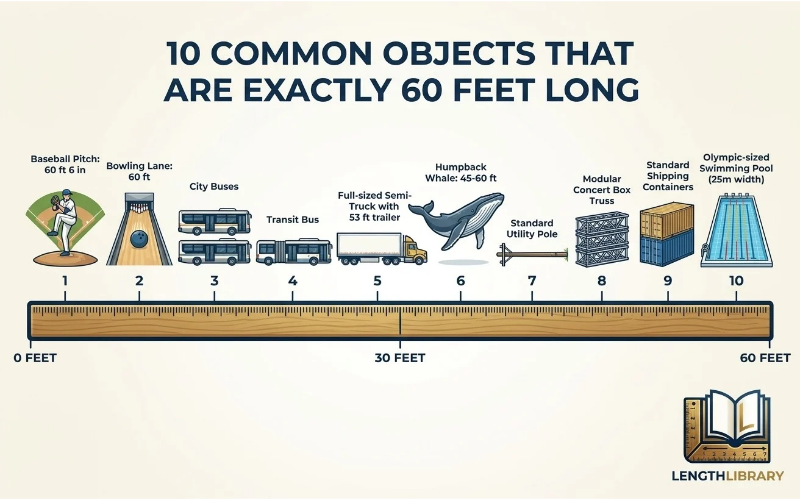
When you try to picture distances in your head, abstract numbers often fall flat. Saying something measures sixty feet long conveys a dimension, but your mind naturally grasps space far better through physical context. Understanding length becomes effortless once you link that exact measurement to tangible items that surround you every single day.
Sixty feet equals roughly eighteen point two nine meters, or exactly seven hundred and twenty inches. To give you an instant mental baseline, that length equals the total height of a five-story residential building, two standard transit buses parked bumper-to-bumper, or two-thirds of a professional basketball court.
Here is a complete breakdown of common structures, vehicles, and objects that hit this precise sixty-foot marker, along with a quick reference guide to help you estimate distances anywhere you go. ⚡
Quick Answer: What Does 60 Feet Look Like? ⚡
If you need a fast mental shortcut right now, picture any of these recognized items:
- Baseball Diamond Pitching Distance: The precise gap between the pitcher’s rubber and home plate (60 ft 6 in).
- Two Standard City Buses: Two typical public transit buses parked nose-to-tail.
- Bowling Lane: The total distance from the foul line straight to the headpin.
- Standard Semi-Truck Trailer: An extra-long 53-foot commercial trailer combined with its front cab connector.
- Six-Story Building Height: A standard low-rise apartment block turned on its side.
Was this visual helpful?
Yes No
Everyday Objects That Measure Exactly 60 Feet 🏬
1. The Distance from a Baseball Pitcher’s Mound to Home Plate ⚾
Baseball fans know this distance by heart. Major League Baseball mandates that the precise distance from the front edge of the pitcher’s rubber to the apex of home plate measures 60 feet and 6 inches (18.44 meters).
When a major league pitcher unleashes a 95 mph fastball across those sixty feet, the baseball reaches the catcher’s mitt in roughly 0.4 seconds. That narrow 60-foot gap has defined the battle between hitter and pitcher for over a century, creating the perfect balance between human reaction time and physical aerodynamics.
2. A Standard Bowling Lane (Foul Line to Headpin) 🎳
When you step up to bowl on frame one, you look straight down a narrow wooden or synthetic lane toward ten wooden pins. The distance from the foul line to the center of the headpin measures exactly 60 feet (18.29 meters).
While the total physical structure of the lane including the approach area and the mechanical pinsetter behind the pit spans about 87 feet, the active play area where the ball rolls covers this exact 60-foot length. That distance gives bowlers enough room to generate hook, spin, and velocity before impact.
| Bowling Lane Spec | Dimension (Feet / Inches) | Dimension (Meters) |
| Active Lane Length | 60 Feet 0 Inches | 18.29 m |
| Approach Area | 15 Feet 0 Inches | 4.57 m |
| Lane Width | 3 Feet 5 Inches | 1.05 m |
| Total Structure Length | 87 Feet 0 Inches | 26.52 m |
3. Two Standard Public Transit Buses Parked End-to-End 🚌
Standard city transit buses running along urban routes measure 30 feet to 40 feet long. The most common single-deck public transit bus used in municipal fleets measures almost precisely 30 feet in overall bumper length.
When you align two of these standard 30-foot city transit buses bumper-to-bumper, you form a continuous line measuring exactly 60 feet. Next time you spot two city buses parked at a transit depot or traffic light, you are looking at a real-world ruler for sixty feet.
4. An Articulated City Bus (Accordion Bus) 🚍
If single buses aren’t nearby, look for an articulated transit bus—often called an “accordion bus” due to the flexible rubber bellows connecting the two frame sections.
Transit authorities in major metropolitan areas utilize these extra-long buses to move heavy passenger loads along busy corridors. Standard articulated buses in North America build on a combined 60-foot chassis design. The front passenger cabin measures 35 feet, while the rear module adds another 25 feet across the pivoting middle joint.
- Front Module Length: ~35 feet
- Pivot Joint: ~2 feet
- Rear Module Length: ~23 feet
- Total Vehicle Length: 60 feet
5. A Full-Sized Semi-Trailer Truck Assembly 🚚
Commercial freight transport relies on standardized shipping containers and trailers. The longest standard tractor-trailer rig operating without special wide-load permits features a 53-foot box trailer.
When you attach a standard day-cab tractor unit to the front of a 53-foot trailer, the kingpin overlap reduces the overall bumper-to-bumper vehicle footprint to right around 60 to 65 feet total. That massive length represents the backbone of modern highway cargo delivery.
6. The Length of an Adult Humpback Whale 🐋
Nature provides incredible scale through marine megafauna. Fully grown adult Humpback Whales (Megaptera novaeangliae) reach average body lengths ranging between 45 and 60 feet (14 to 18 meters), with mature females often reaching the upper edge of that scale.
Imagine a living mammal with flippers spanning 15 feet wide and a body weighing up to 40 metric tons stretching across the full length of a bowling lane. Spotting a female humpback swimming beside a boat offers a vivid demonstration of 60 feet in nature.
7. A Standard Utility Pole Laid flat on the Ground ⚡
You pass utility poles along suburban roads daily without paying much attention to their physical dimensions. Standard wooden utility poles installed by electricity and telecommunications providers range from 30 to 120 feet tall.
However, heavy-duty commercial transmission lines running through major intersections use standard 60-foot wooden or steel utility poles. Power companies bury about 10% of the pole underground (around 6 to 8 feet), leaving a 52-to-54-foot structure standing high above street level.
8. Two Standard Shipping Containers Placed End-to-End 📦
Intermodal freight relies on standardized steel shipping containers (TEUs). The single most ubiquitous container size sitting in freight yards and on cargo ships measures 30 feet in special applications or, more commonly, 20-foot and 40-foot units.
If you place three standard 20-foot shipping containers or pair a 20-foot container with a 40-foot container end-to-end, you create a seamless line of corrugated steel stretching exactly 60 feet.
9. A Standard Concert Box Truss Section Stack 🎪
Event production companies build massive outdoor concert stages using modular aluminum box trusses. Stage crews assemble lighting grids, sound arrays, and screen rigging out of standard 10-foot truss segments bolted together.
Six standard 10-foot aluminum truss segments bolted end-to-end form a single 60-foot structural span. Stage engineers use this exact 60-foot width as the baseline span for main festival stages around the globe.
10. The Width of an Olympic-Sized Swimming Pool 🏊
While people usually associate Olympic swimming pools with their famous 50-meter (164-foot) length, their standard width is equally standardized. An official World Aquatics (FINA) compliant competition pool spans 25 meters wide, but smaller high-school and community training facilities build short-course lanes across a width of roughly 60 feet (8 lanes measuring 7.5 feet wide each).
Stepping up to the starting blocks at a regional aquatic center and looking across eight lanes gives you a direct visual across a 60-foot expanse of water.
Technical Conversion Table: 60 Feet in Other Units 📊
To help you convert sixty feet into alternative metric and imperial measurement systems instantly, review the exact mathematical conversions below:
| Measurement System | Converted Value | Exact Formula |
| Meters | 18.288 m | 60 ft×0.3048 |
| Centimeters | 1,828.8 cm | 60 ft×30.48 |
| Inches | 720 in | 60 ft×12 |
| Yards | 20 yd | 60 ft÷3 |
| Kilometers | 0.018288 km | 18.288 m÷1000 |
| Miles | 0.01136 mi | 60 ft÷5,280 |
BioWiki: Spatial Profile & Object Summary 📖
| Metadata Field | Profile Details |
| Target Measurement | 60 Feet (18.288 Meters / 720 Inches) |
| Category | Physical Distance, Spatial Dimensions, Real-World Objects |
| Primary Domain | Everyday Physics, Measurement Reference, Sports Dimensions |
| Key Anchor Objects | Bowling Lane, Baseball Pitcher’s Mound, Articulated Bus |
| Common Uses | Spatial estimation, site planning, sports field layouts, cargo transport |
| Equivalent Height | ~5 to 6-Story Residential Building |
| Walking Time | ~14 to 15 paces (average adult stride) |
How to Estimate 60 Feet Without a Tape Measure 🚶
You don’t need a heavy tape measure in your pocket to calculate 60 feet on the fly. Try these three physical estimation tricks:
- The Pace Method: An average adult stride measures roughly 2.5 feet from heel to toe during a normal walking pace. Count 24 steps in a straight line, and you will stand roughly 60 feet from your starting mark.
- The Parking Space Rule: Standard perpendicular parking spaces measure 8.5 to 9 feet wide. Count across 7 adjacent parking spots in a retail parking lot to estimate a 60-foot span.
- The Car Length Rule: The average full-size sedan or mid-size SUV measures roughly 15 feet long from bumper to bumper. Picture 4 sedans parked bumper-to-bumper in a straight line.
More Articles to Explore:
- 10 Common Everyday Objects That Are Exactly 50 Feet Long
- 10 Common Everyday Objects That Are Exactly 40 Feet Long
- 10 Common Everyday Objects That Are Exactly 30 Feet Long
- 10 Common Everyday Objects That Are Exactly 20 Feet Long
- 10 Common Everyday Objects That Are Exactly 10 Feet Tall
Frequently Asked Questions (FAQs) ❓
How many meters is 60 feet?
60 feet equals exactly 18.288 meters. You can calculate this conversion by multiplying the number of feet by the official conversion factor of 0.3048.
How many paces does it take to walk 60 feet?
It takes roughly 24 normal walking paces for an average adult to cover 60 feet. If you take intentionally long strides (about 3 feet per stride), you can cover the distance in 20 paces.
Is 60 feet equal to a multi-story building height?
Yes. Sixty feet corresponds to the height of a 5 to 6-story building, assuming standard ceiling heights of 10 to 12 feet per floor inclusive of floor slabs and infrastructure channels.
How long is a 60-foot line compared to a basketball court?
A regulation NBA basketball court measures 94 feet long by 50 feet wide. Therefore, a 60-foot line spans roughly 64% of the court’s total length and easily exceeds its width.
Conclusion 🏁
Visualizing distances gets far easier when you abandon dry numbers and look at the physical objects around you. Sixty feet isn’t just an abstract measurement it’s the exact distance a bowling ball travels to hit a headpin, the length of an articulated city bus navigating downtown streets, the size of a fully grown humpback whale, and the classic gap between a baseball pitcher and home plate.
Next time you need to estimate sixty feet on a job site, out in the field, or during a project, just visualize four sedans parked in a row or picture yourself standing on the foul line of a bowling lane. Using these everyday visual anchors gives you an instant, accurate spatial sense every single time.
📏 Keep Exploring Measurements
Discover more practical guides about everyday lengths, measurements, conversions, and useful size references.