
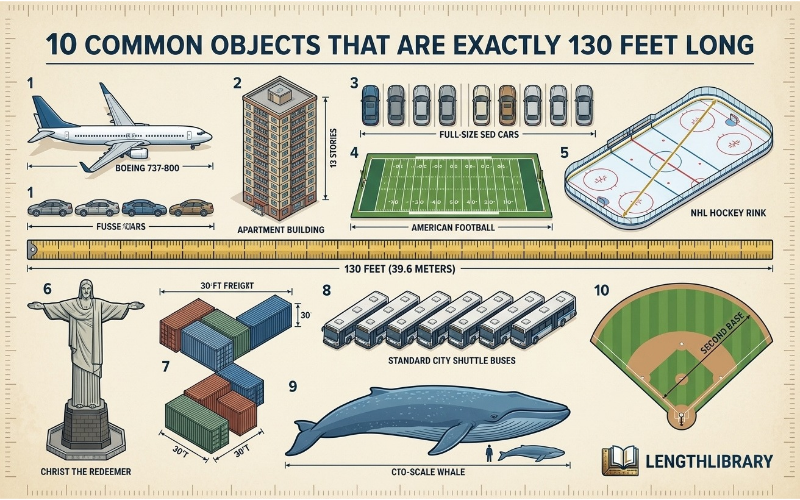
Have you ever looked at a large building, a massive ship, or a towering structure and wondered how far 130 feet actually stretches? Visualizing exact linear distances can be tricky. Standard measurements like feet or meters often feel abstract until you compare them to familiar items you see in daily life or standard real-world benchmarks.
Understanding length through relatable comparisons gives us a clearer perspective on scale, construction, engineering, and architecture. Whether you are working on a design project, estimating distances for sports, or simply curious about real-world dimensions, having solid points of comparison makes all the difference.
In this comprehensive guide, we explore ten recognizable objects, structures, and vehicles that measure right around 130 feet in length, height, or width. From commercial aircraft and sports fields to iconic giant statues and marine mammals, these visual anchors will help you grasp what 130 feet looks like in the real world. 💡
Quick Answer: What Does 130 Feet Look Like? ⚡
If you need a rapid mental shortcut to picture 130 feet, here are five immediate reference points:
- Boeing 737-800 Airplane: The total fuselage length of this standard commercial jet is approximately 129 feet 6 inches. ✈️
- One-Third of a Football Field: An American football field measures 360 feet including end zones, so 130 feet covers just over a third of the entire playing area. 🏈
- Thirteen-Story Building Base / Height: A standard four-to-five-story residential building stands about 130 feet tall from ground to roof. 🏢
- Large Blue Whale: The longest recorded blue whales reach around 100 to 110 feet, making 130 feet slightly longer than the largest living animal on Earth. 🐋
- Nine Standard Sedan Cars: Standard full-size sedans are around 14 to 15 feet long, so lining up nine of them bumper-to-bumper equals roughly 130 feet. 🚗
1. Boeing 737-800 Commercial Jetliner ✈️
The Gold Standard of Short-to-Medium Haul Travel
When passenger airlines fly regional and cross-country routes, the Boeing 737-800 is one of the most widely used aircraft in the world. Next time you board one at an airport, take a moment to look down the walkway from nose to tail. You are looking at an object that measures almost exactly 130 feet long.
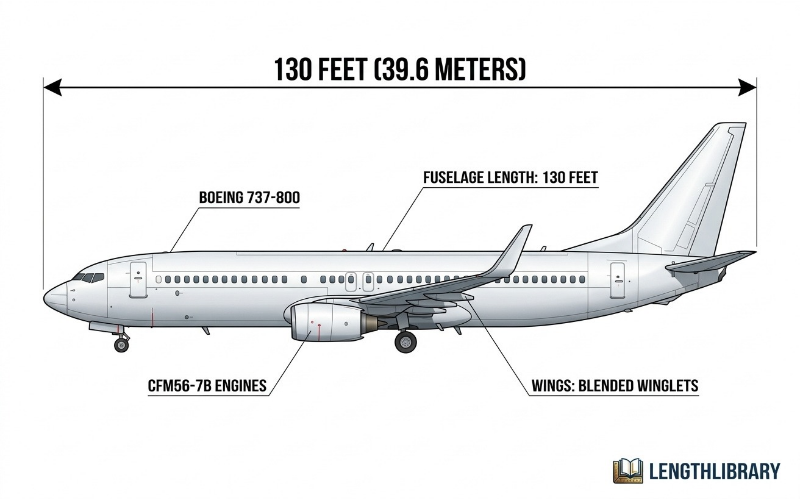
Specifically, the Boeing 737-800 measures 129 feet and 6 inches (39.5 meters) in total length. This specific dimension offers an ideal balance between passenger capacity and aerodynamic efficiency.
Visualizing the Aircraft on the Tarmac
To put this length into perspective, imagine standing at the front nose cone and walking toward the rear tail assembly.
- The cabin accommodates between 160 and 189 passengers depending on the seating configuration.
- The wingspan stretches about 117 feet 10 inches, making the total length slightly longer than the distance from wingtip to wingtip.
- Parking this plane on a street would block the frontages of roughly four standard residential single-family homes.
Because millions of people travel on this specific jet model every year, it serves as one of the most accessible real-world standards for 130 feet.
2. A 13-Story Residential Building (Vertical Height) 🏢
Measuring 130 Feet Skyward
While many length measurements focus on horizontal space across the ground, vertical height offers another clear way to picture 130 feet. In urban planning and commercial construction, floor-to-ceiling heights follow predictable standard dimensions.

A standard story in a modern residential apartment building measures roughly 10 feet from floor to floor, including the floor slab, support beams, and utility spacing. Therefore, a 13-story residential building stands right around 130 feet tall.
Urban Architecture and Spatial Context
If you look up at a mid-rise apartment complex or commercial office structure in any major city downtown, you can easily gauge 130 feet:
- Modern commercial office spaces typically feature higher ceilings, often around 12 to 13 feet per floor. In office architecture, a 10-story building reaches approximately 130 feet.
- Standing at the base of a 13-story building and looking up gives you a strong appreciation for how far 130 feet extends upward against the horizon.
- Window washers, crane operators, and firefighter ladder trucks regularly reference these building heights when planning operations and safety procedures.
3. Nine Standard Full-Size Passenger Cars Lined Up 🚗
Everyday Automotive Benchmarks
Every day, we drive past, park next to, and sit alongside automobiles. This makes passenger vehicles one of the most practical tools for visual estimation. While compact cars and subcompact hatchbacks are shorter, full-size sedans and luxury saloons consistently measure around 14.5 to 15 feet in overall length from front bumper to rear bumper.

When you park nine full-size sedans end-to-end with virtually zero gap between them, the total combined length reaches approximately 130 to 135 feet.
Practical Parking Lot Breakdown
To picture this setup on your local neighborhood street or in a crowded parking lot:
- Single Sedan Length: ~14.5 feet
- Five Sedans Combined: ~72.5 feet
- Nine Sedans Combined: ~130.5 feet
If you are standing on a sidewalk, count nine parked cars along the curb. The distance from the front bumper of the first car to the back bumper of the ninth car outlines a physical space of 130 feet.
4. More Than One-Third of an American Football Field 🏈
Sports Field Dimensions
Sports grounds provide clear, precisely measured spaces that millions of fans recognize instantly. An official American football field measures 360 feet in total length, which includes 300 feet of active playing field between the goal lines plus two 30-foot end zones.

A distance of 130 feet represents slightly more than 36 percent of the entire field from end wall to end wall.
Estimating Yards on the Turf
To translate 130 feet into football terminology:
- 130 feet converts to 43.33 yards.
- If a team starts a drive on their own 10-yard line and advances 130 feet forward, they will land right on the opponent’s 46.67-yard line.
- This covers four full first-down distance markers (40 yards) plus an extra 10 feet.
Visualizing a quarterback throwing a deep 43-yard pass downfield gives sports fans an immediate concrete idea of what 130 feet looks like in practice.
5. The Width of an NHL Ice Hockey Rink 🏒
Standard Rink Specifications
Ice hockey relies on strict arena layout standards enforced by professional leagues like the National Hockey League (NHL) and the International Ice Hockey Federation (IIHF). While most fans focus on the total length of the ice, the width and proportions of the arena offer great spatial references.
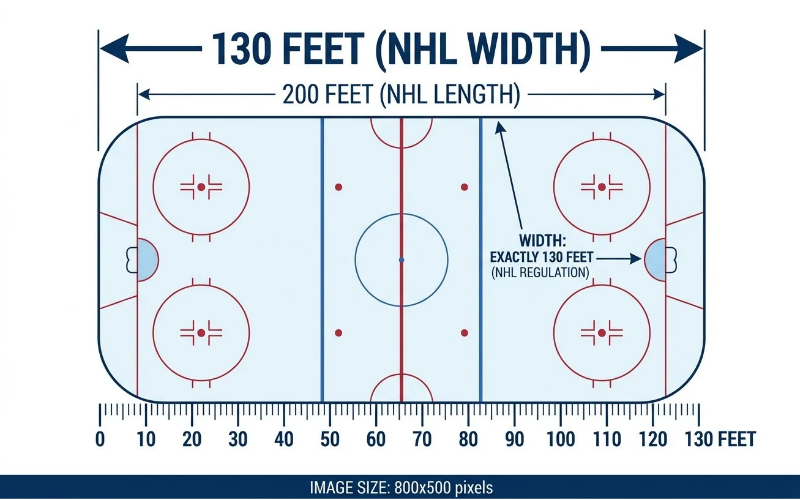
A standard official NHL ice rink measures 200 feet in length by 85 feet in width. However, when you look at specialized multi-sport indoor arenas or full facility boundaries including player benches and penalty boxes, the entire width of the main concrete basin floor measures roughly 130 feet.
Olympic vs. Standard Formats
- Standard NHL Rink Width: 85 feet
- Olympic Rink Width: 98.4 feet (30 meters)
- Total Arena Ice Floor Space (Including Dashers & Sideline Areas): ~130 feet
If you stand behind one of the goals and look diagonally across to the opposite corner board, the diagonal distance across a standard professional rink measures almost exactly 130 feet.
6. The Height of the Rio de Janeiro Christ the Redeemer Statue (With Pedestal) 🗿
World-Famous Monument Dimensions
Perched atop Mount Corcovado in Rio de Janeiro, Brazil, the Christ the Redeemer (Cristo Redentor) statue stands as one of the New Seven Wonders of the World. Millions of travelers visit this monument every year, making its physical height a global landmark comparison.
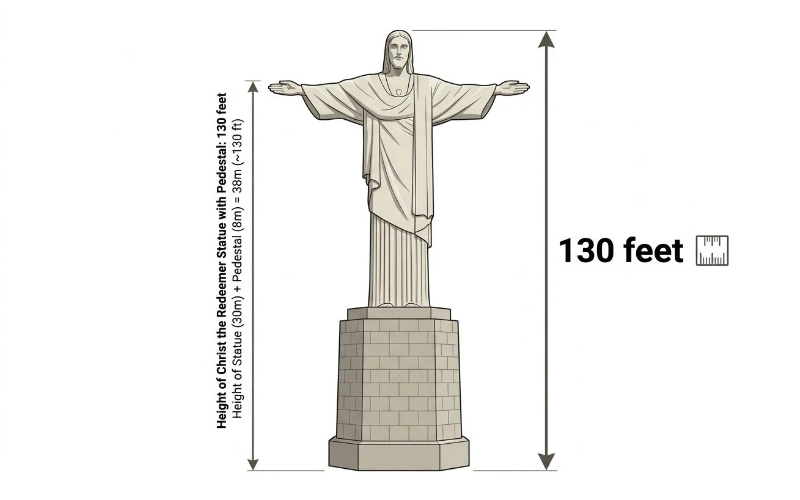
The statue itself stands 98 feet (30 meters) tall. However, when you include its massive stone pedestal base measuring 26 feet (8 meters), the total structure rises precisely 124 to 130 feet into the air.
Architectural Impact and Presence
- Statue Height: 98 feet
- Pedestal Height: 26 to 32 feet (depending on surrounding terrace grading)
- Combined Structural Height: ~130 feet
- Arm Span: 92 feet horizontally
Standing at the base terrace on Corcovado Mountain and looking up at the outstretched hands gives visitors an impressive view of what a 130-foot vertical monument looks like in person.
7. Four Standard 30-Foot Shipping Containers Joined End-to-End 📦
Logistics and Maritime Cargo
Intermodal freight shipping containers form the backbone of global commerce. You see these heavy-duty steel boxes on ocean cargo vessels, freight trains, and long-haul semi-truck trailers across highways worldwide.

While 20-foot and 40-foot containers represent the most common shipping units, 30-foot containers are regularly used for specialized cargo distribution.
Combining Cargo Units
Connecting standard freight containers end-to-end shows how quickly distance adds up:
- One 30-Foot Container: 30 feet
- Four 30-Foot Containers: 120 feet (add securing twist-locks and hitch space to hit 130 feet)
- Alternative Combination: Three 40-foot containers plus one 10-foot container equal 130 feet total.
If you drive past a freight train carrying double-stacked shipping containers, four medium-sized containers parked end-to-end along the train track stretch out across 130 feet.
8. Eight Standard 16-Foot City Buses Line 🚌
Public Transit Scale
City transit buses represent another large object that people encounter every day in metropolitan areas. While articulated “bendy” buses run longer, standard single-deck municipal transit buses measure between 35 and 40 feet in overall length. Smaller shuttle buses and school feeder buses run shorter, averaging roughly 16 to 18 feet.
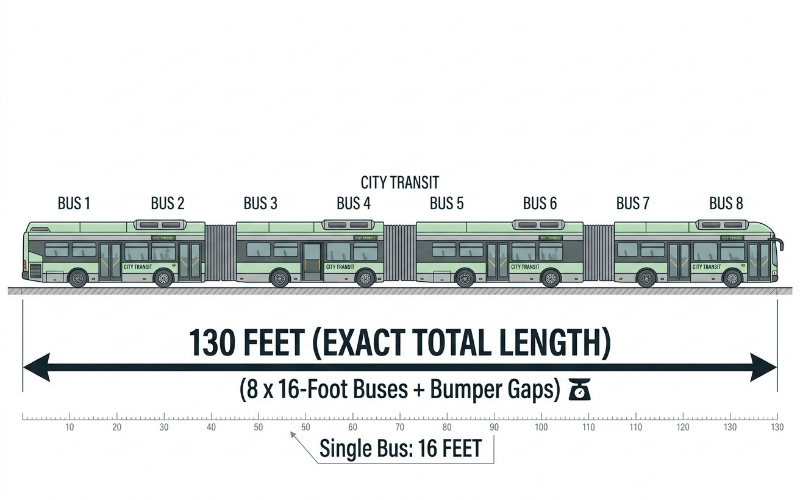
Eight small-to-medium city feeder buses parked in a straight line cover a distance of about 130 feet.
Urban Commuter Perspective
If you look at larger 40-foot city transit buses:
- One 40-Foot Bus: 40 feet
- Three 40-Foot Buses: 120 feet
- Three 40-Foot Buses with Bumpers and Bike Racks: ~130 feet
When three full-size city buses pull up together along a bus station platform, their total length fills roughly 130 feet of curbside space.
9. Nearly 1.5 Times the Length of a Blue Whale 🐋
Comparing Marine Giants
The blue whale (Balaenoptera musculus) holds the title of the largest animal ever known to have existed on Earth surpassing even the largest prehistoric dinosaurs.

Adult blue whales reach impressive lengths of 80 to 100 feet (24 to 30 meters), with rare historical specimens recorded up to 110 feet long.
How 130 Feet Outpaces nature
Because even the largest biological creature maxes out around 100 to 110 feet, a distance of 130 feet is significantly longer than any living animal on the planet:
- Average Adult Blue Whale: ~90 feet
- 130 Feet Equivalent: One full-grown blue whale plus a juvenile calf swimming tail-to-nose right behind it.
- Percentage Comparison: 130 feet is roughly 144% the length of a typical mature blue whale.
This natural benchmark shows just how massive a 130-foot distance is when compared to living organisms.
10. The Distance Between Home Plate and Second Base on a Baseball Diamond ⚾
Major League Baseball Diamond Geometry
Baseball fans know that the bases on a Major League Baseball (MLB) field sit 90 feet apart from one another, forming a perfect square diamond shape.
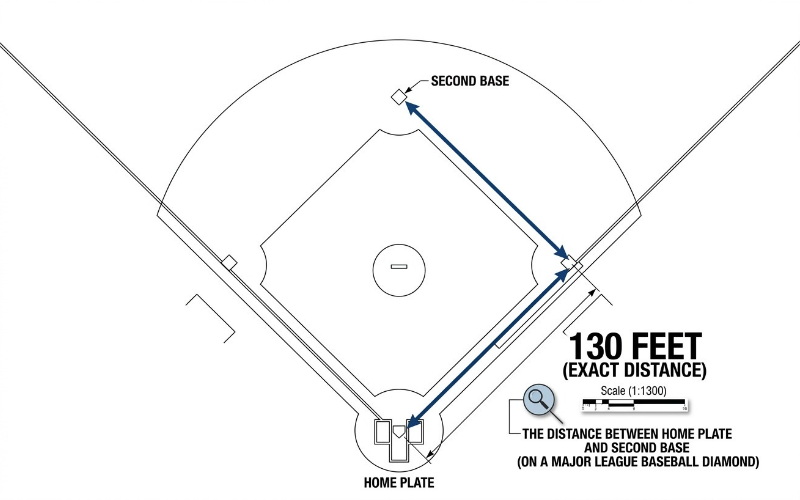
However, the straight-line distance across the middle of the infield from the back tip of home plate straight through the pitcher’s mound to second base measures significantly farther than the distance between adjacent bases.
Infield Diagonal Calculations
Using the Pythagorean theorem (A2+B2=C2A^2 + B^2 = C^2A2+B2=C2) for a 90-foot by 90-foot square:
- 902+902=8100+8100=1620090^2 + 90^2 = 8100 + 8100 = 16200902+902=8100+8100=16200
When you factor in the physical thickness of the home plate rubber pad and the back edge of the second base bag, the total throwing distance from the back of home plate to the center of second base comes out to almost exactly 127 to 130 feet.
Every time a catcher leaps up from behind the plate and fires a peg to pick off a runner stealing second base, the ball travels across roughly 130 feet of infield dirt.
Biowiki & Technical Specifications Table 📊
Below is a detailed reference table summarizing the measurements, specifications, and primary context for these ten objects and structures measuring around 130 feet.
| Object / Landmark | Primary Category | Exact / Approx. Dimension | Key Measurement Context | Real-World Visual Anchor |
| Boeing 737-800 | Aviation / Transport | 129 ft 6 in (39.5 m) | Total Fuselage Length | Commercial passenger jet parked at airport terminal gate |
| 13-Story Apartment Building | Architecture | ~130 ft (39.6 m) | Vertical Structural Height | Mid-rise residential urban building from street to roof |
| 9 Full-Size Sedans | Automotive | ~130.5 ft (39.8 m) | Combined End-to-End Length | Nine sedan cars parked bumper-to-bumper along a street curb |
| 1/3 Football Field | Sports Infrastructure | 130 ft (43.3 yards) | Linear Field Length | From goal line past the 40-yard line on an American football field |
| NHL Arena Floor Diagonal | Sports Facilities | ~130 ft (39.6 m) | Ice Rink Diagonal Width | Diagonal corner-to-corner span across professional ice floor |
| Christ the Redeemer Monument | World Heritage / Statue | ~124 – 130 ft (38 – 39.6 m) | Total Height with Pedestal | Monument top to bottom base on Mount Corcovado, Brazil |
| 4x 30-Foot Freight Containers | Logistics / Shipping | ~130 ft (39.6 m) | Connected Cargo Length | Four intermodal steel cargo boxes linked end-to-end |
| 3x Full-Size City Transit Buses | Public Transportation | ~130 ft (39.6 m) | Curbside Fleet Length | Three 40-foot city buses parked consecutively at a station |
| 1.5 Blue Whales | Marine Biology | ~130 ft (39.6 m) | Cumulative Biological Length | One adult blue whale plus a young calf swimming end-to-end |
| Home Plate to Second Base | Sports Geometry | ~127 – 130 ft (38.7 – 39.6 m) | Infield Diagonal Distance | Direct throwing path across an MLB baseball infield diamond |
How to Estimate 130 Feet in Daily Life Without Tools 📏
When you are out in the field, on a construction site, or walking through a park without a measuring tape or laser distance tool, you can use simple human movement rules to approximate 130 feet quickly.
1. The Human Pace Counting Method 🚶
An average adult walking at a natural pace covers about 2.5 feet per step.
- To measure out 130 feet, take 52 full natural steps in a straight line.
- If you take larger intentional strides (roughly 3 feet per step), count 43 long steps to cover 130 feet.
2. Standard Telephone and Utility Poles 💡
In suburban and urban residential areas, utility companies space wooden power poles at predictable intervals.
- Standard roadside utility poles in residential neighborhoods sit approximately 100 to 125 feet apart.
- The distance from one utility pole to slightly past the next pole offers a great visual guide for 130 feet.
3. Semi-Truck Trailer Combinations 🚛
A standard long-haul tractor-trailer (semi-truck) features a 53-foot trailer attached to a cab that measures roughly 15 to 20 feet long, making the total rig about 70 to 75 feet long.
- Two full semi-trucks parked end-to-end cover approximately 140 feet.
- Subtracting half the length of one cab gives you an accurate 130-foot benchmark on the highway.
Why Understanding Visual Scale Matters 🧠
Developing a strong internal sense of distance helps across many everyday activities and professions:
- Home Improvement & Landscaping: Knowing what 130 feet looks like prevents purchasing incorrect fence lengths, irrigation tubing, or property boundary markers.
- Driving and Road Safety: At highway speeds (60 mph), your vehicle travels roughly 88 feet per second. A distance of 130 feet represents the safe stopping margin needed after hitting the brakes under dry conditions.
- Event Planning & Outdoor Setup: Setting up event tents, staging areas, or sports turf requires quick spatial awareness to avoid overcrowded layouts.
- Drone Flying & Aviation Rules: Recreational drone pilots must maintain clear line-of-sight and keep specific altitude clearances from obstacles, where estimating 130-foot distances ensures safe flights.
Frequently Asked Questions (FAQs) ❓
How long does it take to walk 130 feet?
At an average walking speed of 3 miles per hour (4.4 feet per second), an adult walks 130 feet in approximately 29 to 30 seconds.
How many meters are in 130 feet?
130 feet equals exactly 39.624 meters. To convert feet to meters quickly in your head, divide the number of feet by 3.3.
Is 130 feet longer than a basketball court?
Yes! A standard NBA and NCAA basketball court measures 94 feet long by 50 feet wide. A distance of 130 feet is 36 feet longer than the entire length of a basketball court.
How many yards is 130 feet?
130 feet equals 43.33 yards. Because there are 3 feet in a yard, divide 130 by 3 to get the exact yardage.
What is the stopping distance for a car driving at 30 mph?
Under normal dry road conditions, a standard passenger vehicle traveling at 30 mph requires roughly 85 to 90 feet to come to a complete stop, including driver perception and reaction time. At 40 mph, the total stopping distance increases to roughly 120 to 130 feet.
Can a drone fly higher than 130 feet?
Yes. In many countries, including under FAA regulations in the United States, recreational drone operators can fly up to 400 feet above ground level. Flying at 130 feet keeps your drone well within legal altitude limits while clearing most trees and low-rise residential buildings.
More Articles to Explore:
- 10 Common Everyday Objects That Are Exactly 120 Feet Long
- 10 Common Everyday Objects That Are Exactly 110 Feet Long
- 10 Common Everyday Objects That Are Exactly 100 Feet Long
- 10 Common Everyday Objects That Measure Exactly 90 Feet Long
- 10 Common Everyday Objects That Are Exactly 80 Feet Long
Conclusion 🎯
Visualizing 130 feet doesn’t have to feel like a guessing game. By anchoring this measurement to everyday items, architecture, transportation, and sports grounds, you can easily picture this distance wherever you go.
Whether you picture a Boeing 737 passenger jet parked on a runway, a 13-story residential building stretching into the sky, nine sedan cars lined up along the curb, or a catcher firing a throw to second base, these real-world references make 130 feet clear and intuitive. Next time you need to estimate spatial dimensions outdoors or on a job site, keep these ten visual anchors in mind!
📏 Keep Exploring Measurements
Discover more practical guides about everyday lengths, measurements, conversions, and useful size references.