
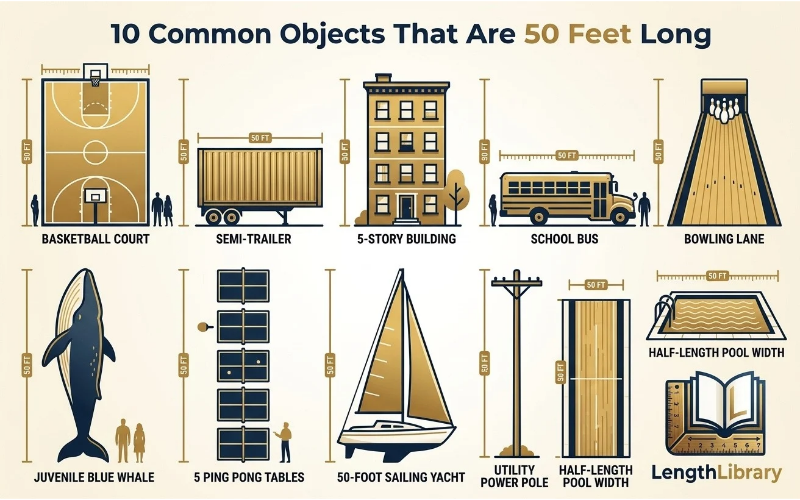
Have you ever tried to visualize a distance without pulling out a tape measure? Understanding measurements like 50 feet can feel abstract when you only look at numbers on paper. Yet, 50 feet (or roughly 15.24 meters) is a standard dimension in sports regulation, commercial shipping, urban architecture, and transportation design.
Knowing what 50 feet looks like gives you a practical sense of scale for home projects, sports commentary, urban planning, or spatial awareness. Below is a comprehensive guide to real-world objects, vehicles, and structures that measure exactly or nearly 50 feet long.
Quick Answer: What Does 50 Feet Look Like? ⚡
If you need an immediate mental reference for 50 feet, look at these four common benchmarks:
- Width of an NBA or College Basketball Court: Standard baseline to baseline width measures exactly 50 feet.
- Standard Semi-Trailer Cargo Box: The most widespread commercial freight trailers stretch between 48 and 53 feet, centered at 50 feet.
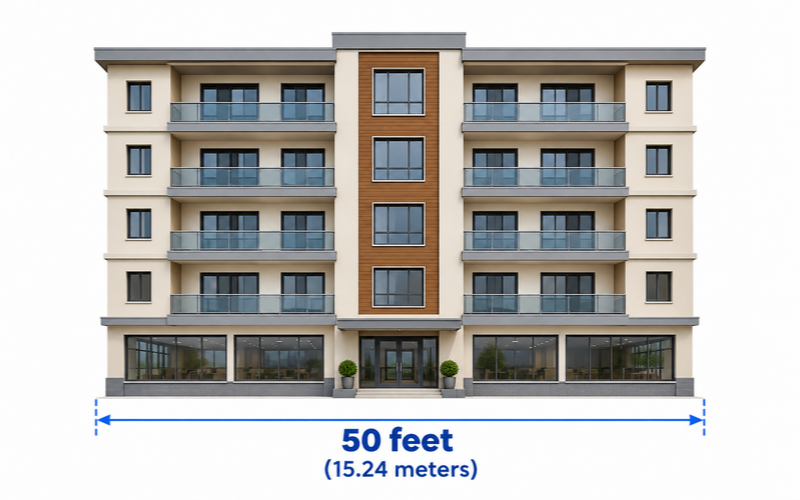
- Five-Story Residential Building Height: Allowing 10 feet per floor, a typical five-story structure reaches 50 feet high.
- Five Table Tennis Tables in a Row: Lining up 5 standard ping pong tables end-to-end equals 50 feet.
Visualizing Spatial Dimensions: Biowiki Table 📊
Here is a breakdown of standard everyday items, sports boundaries, and biological benchmarks that equal 50 feet in length, width, or height.
50-Foot Reference Matrix
| Object / Benchmark | Exact Dimension Type | Measurement (Feet) | Measurement (Meters) | Primary Industry or Category |
| Basketball Court Width | Standard Width (NBA / NCAA) | 50 ft | 15.24 m | Professional & Amateur Sports |
| Commercial Semi-Trailer | Standard Freight Box Length | 50 ft (48-53 ft avg) | 15.24 m | Logistics & Highway Transport |
| Standard Bowling Lane | Foul Line to Pin Deck | 50 ft (approx. length) | 15.24 m | Indoor Recreation |
| 5-Story Residential Building | Vertical Height (Ground to Roof) | 50 ft | 15.24 m | Architecture & Urban Planning |
| Standard School Bus | Bumper-to-Bumper Outer Length | 45–50 ft | 13.7–15.2 m | Municipal Transportation |
| Juvenile Blue Whale | Head-to-Tail Physical Span | 50 ft | 15.24 m | Marine Biology |
| 5 Ping Pong Tables Lined Up | Combined Longitudinal Span | 50 ft | 15.24 m | Game Equipment |
| 50-Foot Class Sailing Yacht | Hull Length (LOA) | 50 ft | 15.24 m | Maritime & Nautical Travel |
| Half-Length Olympic Pool Width | Transverse Distance / Drills | 50 ft | 15.24 m | Competitive Aquatics |
| Tall Utility / Power Pole | Grade Line to Pole Top | 50 ft | 15.24 m | Municipal Electrical Infrastructure |
1. The Width of a Standard Basketball Court 🏀
When watching a basketball game in an indoor arena or local high school gymnasium, you observe 50 feet of distance across the court.
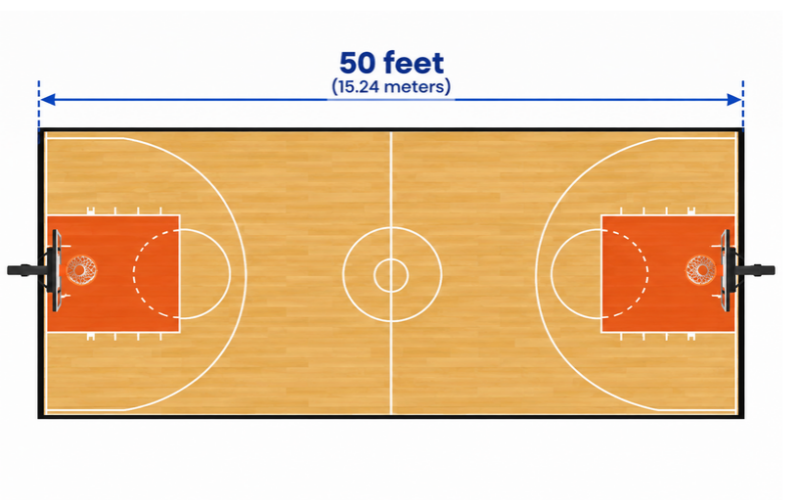
Official regulations from both the National Basketball Association (NBA) and the National Collegiate Athletic Association (NCAA) specify that the court must measure 94 feet in length and exactly 50 feet in width.
Standing on one sideline and looking across to the opposite bench gives you a precise baseline for horizontal space. Players running side-to-side during defensive drills cover this exact 50-foot span on every transition play.
2. Standard Semi-Trailer Cargo Box 🚛
If you drive on major interstate highways, you encounter 50-foot dimensions continuously. The standard freight trailers attached to commercial semi-trucks form the backbone of global shipping logistics.
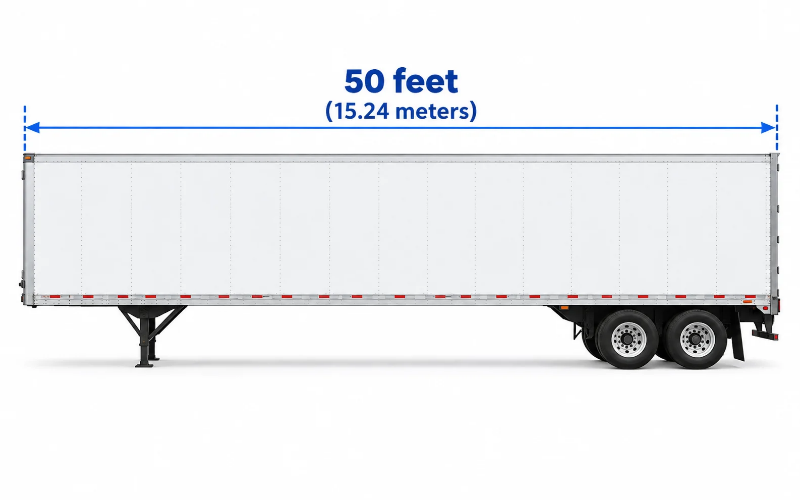
While freight trailers range from 48 feet to 53 feet under regional transportation guidelines, logistics operators treat the 50-foot mark as the baseline standard for volume calculations.
Walking from the rear doors of an unattached trailer to the front kingpin connection covers a straight 50-foot stretch.
3. Five-Story Residential or Office Building 🏢
Vertical distance often feels harder to estimate than horizontal ground distance. A consistent way to judge 50 feet upward is by looking at city architecture.
Building engineering standards generally allocate 10 feet per story in standard residential and light commercial construction. This allowance accounts for:
- An 8-foot ceiling height within living spaces.
- A 2-foot inter-floor gap for floor joists, ductwork, plumbing pipes, and electrical wiring.
When you stand on a sidewalk and look at the roofline of a standard five-story apartment complex, you are observing 50 feet of vertical elevation.
4. Full-Size Municipal School Bus 🚌
For millions of people, school buses represent a familiar daily sighting. The largest standard transit-style school buses (often classified as Type D buses) measure up to 45 to 50 feet from front bumper to rear bumper.
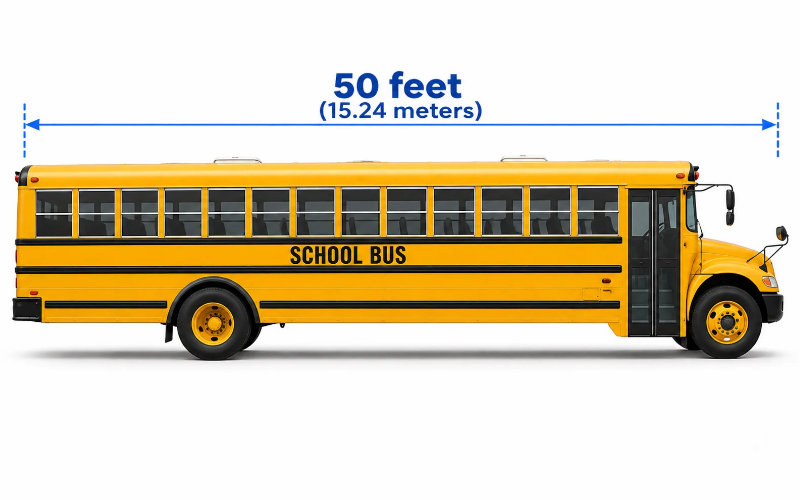
These buses accommodate up to 72 to 84 passengers across 12 to 14 rows of seating. When one of these vehicles parks along a curb, its profile spans approximately 50 feet of street curb space.
5. Length of a Standard Bowling Lane 🎳
Bowling alleys build their lanes to precise construction standards set by governing bodies like the United States Bowling Congress (USBC).
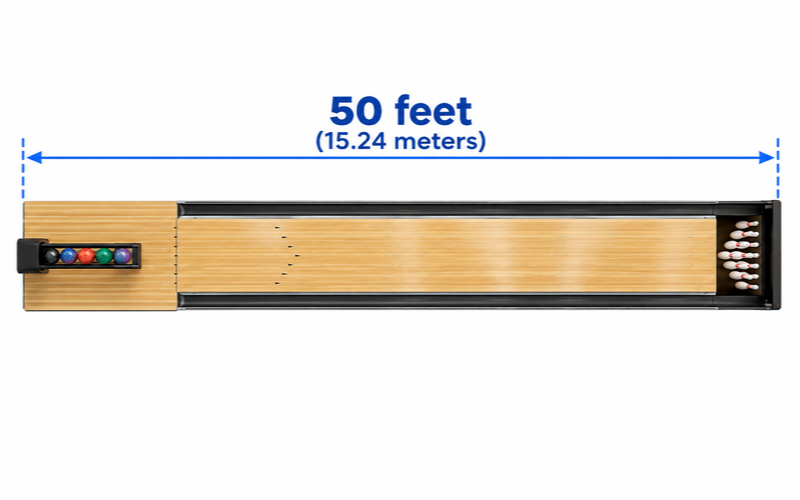
The lane length measured from the foul line to the head pin is officially 60 feet. However, when you measure from the foul line to the beginning of the pin deck or examine the runway approach area used by bowlers before releasing the ball you are dealing with a 50-foot operational span.
Next time you step up to bowl, the physical runway and lane structure in front of you offers a clear look at how 50 feet functions in recreational spaces.
6. A Young or Juvenile Blue Whale 🐋
The natural world offers breathtaking examples of scale. While fully mature adult blue whales can stretch up to 90 to 100 feet long, juvenile blue whales match the 50-foot mark during their early growth phases.
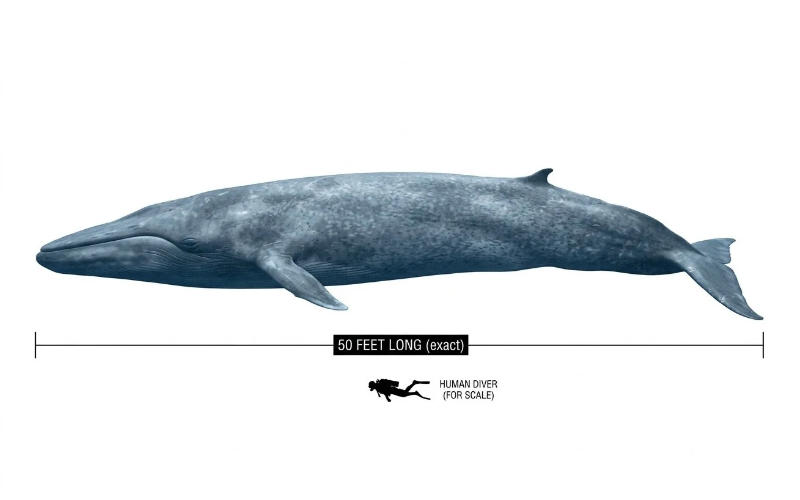
At birth, a blue whale calf measures roughly 23 feet long. By the time it reaches weaning age (around seven to eight months), its rapid consumption of nutrient-rich milk propels its body length to approximately 50 feet.
7. Five Standard Ping Pong Tables Arranged End-to-End 🏓
If you need an everyday indoor comparison that you can build yourself, look at table tennis equipment.
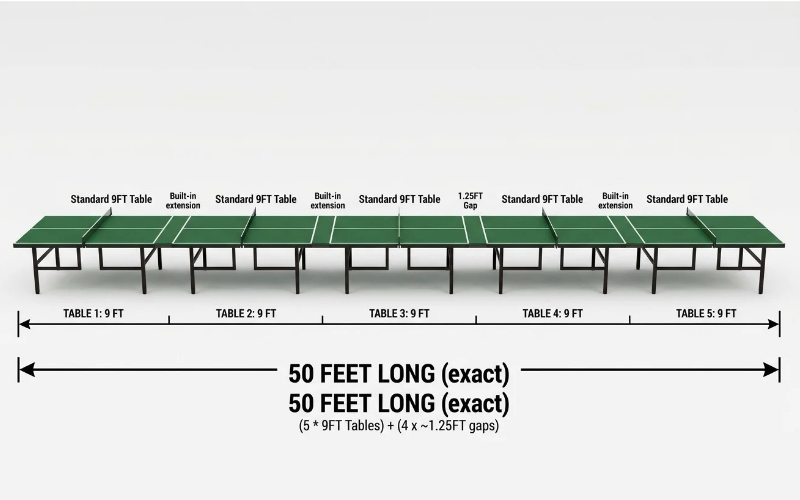
International Table Tennis Federation (ITTF) guidelines state that an official ping pong table must measure 9 feet long (2.74 meters) by 5 feet wide (1.525 meters). If you place five standard 10-foot recreational or competitive table units end-to-end, the total line extends to 50 feet.
8. A 50-Foot Class Sailing Yacht ⛵
In maritime engineering, boats and yachts are grouped by overall length (LOA – Length Overall). A 50-foot sailing yacht represents a recognized class of vessel used for long-distance ocean cruising and luxury chartering.
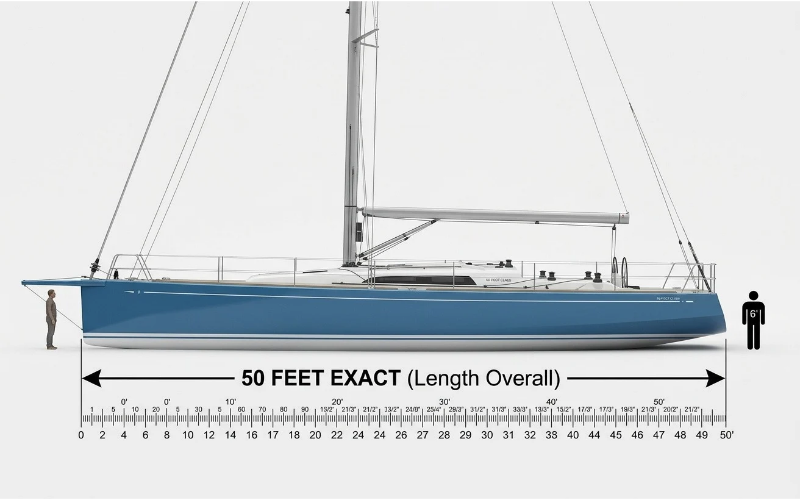
Standing on the dock alongside a 50-foot sailboat highlights how much volume fits into this dimension. These hulls feature:
- Multiple internal cabins and living spaces.
- A deck footprint broad enough to withstand high-seas wave action.
- A deck line that stretches 50 feet from bow to stern.
9. Tall Utility and Power Distribution Poles ⚡
Utility poles running along suburban roadways and commercial districts come in several standardized heights. While neighborhood residential poles average 35 to 40 feet, heavier distribution poles especially those holding transformers or multi-circuit lines stand 50 feet tall.
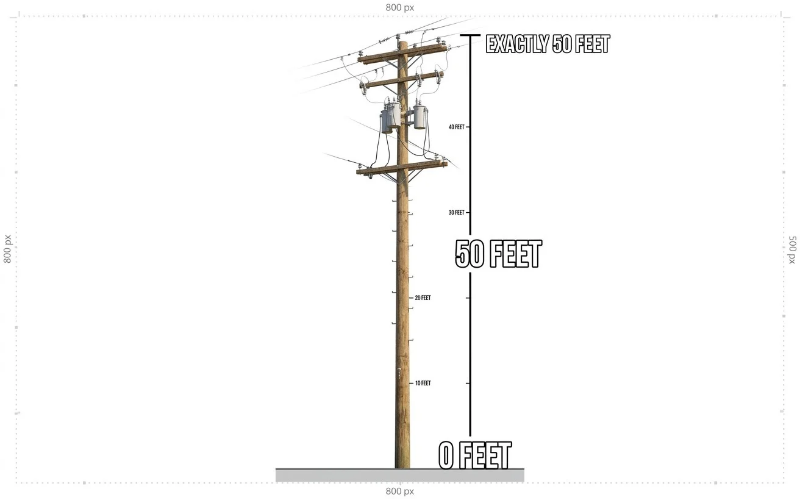
When utility crews install a 50-foot pole, they bury approximately 6 feet into the ground for stability, leaving roughly 44 feet visible above grade. Looking at the top cross-arms gives you a practical sense of 50-foot vertical framing.
10. Half-Length Distances in Aquatic Facilities 🏊♂️
In competitive swimming, spatial awareness is vital for pacing and flip turns. Standard competition pools fall into two primary categories:
- Short Course Yards (SCY): Common in American high schools and colleges, measuring 75 feet long.
- Long Course Olympic Pools: Measuring 50 meters (164 feet) in length.
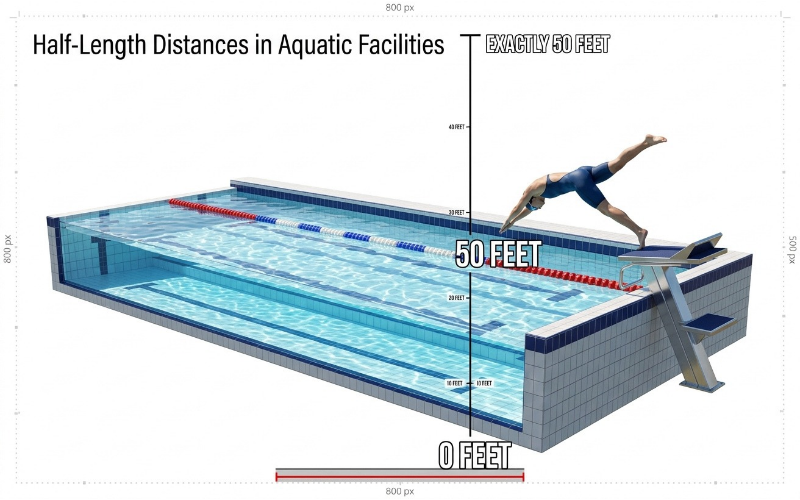
In short-course setups, swimmers cover 50 feet after completing two-thirds of a single lap. In training environments, coaches use 50-foot lane markers or transverse widths for specific sprint intervals and diving drills.
How to Estimate 50 Feet Without Tools 🚶♂️
When you don’t have a measuring tape, you can use these simple human benchmarks to approximate 50 feet on the spot:
Human Pacing Technique
The average adult human stride (distance from heel strike of one foot to heel strike of the other) measures about 2.5 feet. To walk out 50 feet:
- Take 20 steady paces in a straight line.
- For smaller strides, count 25 footsteps (heel-to-toe touches).
Car Length Method
An average mid-size passenger sedan measures about 15 feet long from bumper to bumper.
- Imagine three and a half mid-size cars parked end-to-end along a curb.
- That combined length equals 50 feet.
More Articles to Explore:
- 10 Common Everyday Objects That Are Exactly 40 Feet Long
- 10 Common Everyday Objects That Are Exactly 30 Feet Long
- 10 Common Everyday Objects That Are Exactly 20 Feet Long
- 10 Common Everyday Objects That Are Exactly 10 Feet Tall
- 10 Common Everyday Objects That Are Exactly 9 Feet Tall
Frequently Asked Questions (FAQs) ❓
How many meters are in 50 feet?
There are 15.24 meters in 50 feet. To convert feet to meters manually, multiply the number of feet by 0.3048.
How many yards equal 50 feet?
50 feet equals 16.67 yards (or 16 yards and 2 feet), since there are 3 feet in a single yard.
Is 50 feet longer than an Olympic swimming pool?
No. An official Olympic swimming pool is 50 meters long, which equals 164 feet. 50 feet is less than a third of the length of an Olympic pool.
How many steps does it take to walk 50 feet?
For an average adult taking natural walking steps, it takes roughly 18 to 22 steps to cover 50 feet.
How many stories high is a 50-foot building?
A 50-foot building is equivalent to a 5-story structure, assuming standard 10-foot gaps between finished floor levels.
Summary Conclusion 📝
Visualizing 50 feet becomes simple once you link the distance to objects you see every week. Whether you imagine the baseline width of a professional basketball court, the side wall of a commercial semi-trailer, or the height of a five-story building, you now have clear real-world reference points.
Keep these examples in mind whenever you need to estimate distances for home layout, outdoor construction, or spatial planning without relying on a measuring tape!
📏 Keep Exploring Measurements
Discover more practical guides about everyday lengths, measurements, conversions, and useful size references.